EuroNet MRPH logo with the full name of the network, European Network of Multidisciplinary Residents in Public Health.

Which Social Platform is preferred between Turkish Public Health Residents’ for Communication?

I suppose that this is the first article from Turkey in EURONET-MRPH Newsletter. So, I want to share our experience for communication as first. It is very exciting and important to communicate between European students for us. It is also very important to provide a good communication medium between Turkish residents.

However, it is very difficult to choose best social medium, especially if there are hundreds of residents. For example, it is estimated that there are about 500 public health residents in more than 50 medical schools in Turkey. We use google mail group and whatsapp application to get in contact. Well, most of the residents have hesitations to write or to ask to the mail group, and they find whatsapp more practical then the mail group.

They think that they could get answers to their questions rapidly in whatsapp. Although, whatsapp is preferable for notifications, all residents couldn’t participate to residents’ group due to participant limitation.

As a representative of residents in HASUDER (Turkish Society of Public Health Specialists), i had carried out an online survey to choose the best social medium / media which had continued for ten days in November 2018. Then, we discussed the results to decide communication media in Medical Residents Session of 20th National Public Health Congress, Antalya.

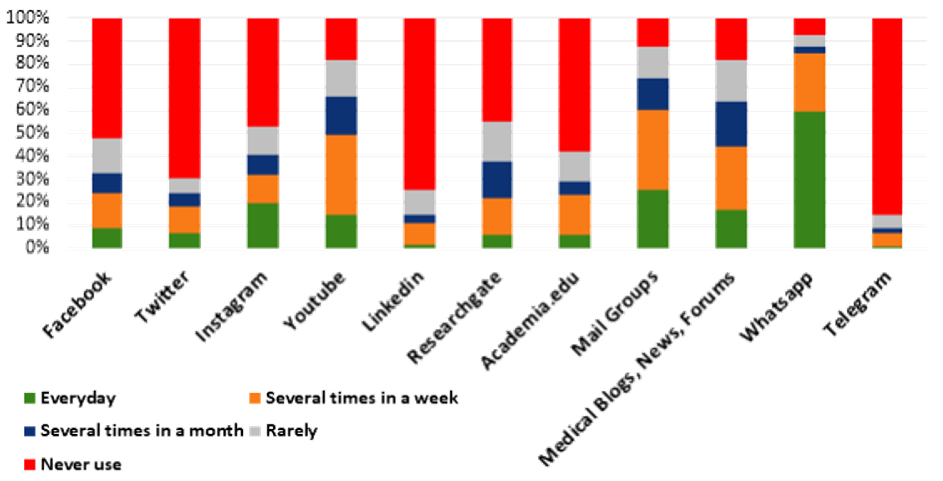
Figure 1. Social Media Use of Public Health Residents for Academic Purposes

Total 156 residents completed the online survey (about 1/3 of all residents). Mean age of participants was 29.3±3.2 years and mean duration of residency was 23.5±15.6 months. About three quarters of the residents (73.7%) was female. Please don’t worry; it is not an error, there is apparently female predominance in Turkish public health residents. Most of the participants (84.5%) specified that they used social media every day. More than 90.0% of residents could interest in social media several times in a week. However, only 76.3% of residents specified that they could interest in social media for academic purposes several times in a week.

Youtube, mail groups and whatsapp application were the most used media for academic purposes (Figure 1).

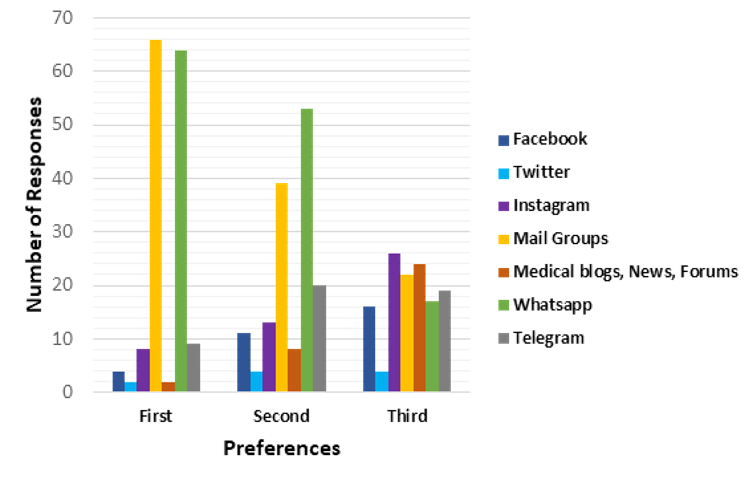
Residents preferred to communicate mostly with mail groups, whatsapp, telegram and instagram for academic communication (Figure 2).

Figure 2. Social Media Communication Preferences of Public Health Residents for Academic Purposes

Youtube, researchgate, linkedin and academia.edu  were excluded for academic communication preferences. Because, they were not suitable for mutual and group communication. Few residents chose medscape and discord under the title of “others” for both in Figure 1 and 2.

It could be concluded that mail groups and whatsapp are trending media. In public health conference , we discussed that whatsapp was not enough, maybe it would be better to change it to telegram according to survey results. Instagram was a surprise in this survey. Perhaps, it might have a function in the future in terms of the public health.

Ferhat Yildiz
MD, Representative of Residents, HASUDER, Turkey

Aydin Adnan Menderes University, School of Medicine

Department of Public Health

Merhaba (Hello)!

References and Social Media resources used

  1. Facebook, www.facebook.com (Accessed in 19th Nov 2018)
  2. Twitter, www.twitter.com (Accessed in 19th Nov 2018)
  3. Instagram, www.instagram.com (Accessed in 19th Nov 2018)
  4. Youtube, www.youtube.com (Accessed in 19th Nov 2018)
  5. Linkedin, www.linkedin.com (Accessed in 19th Nov 2018)
  6. Researchgate, www.researchgate.net (Accessed in 19th Nov 2018)
  7. Academia.edu, www.academia.edu (Accessed in 19th Nov 2018)
  8. Google groups, https://groups.google.com/forum/#!overview (Accessed in 19th Nov 2018)
  9. Whatsapp, www.whatsapp.com (Accessed in 19th Nov 2018)
  10. Telegram, https://telegram.org (Accessed in 19th Nov 2018)
  11. Medscape, www.medscape.com (Accessed in 19th Nov 2018)
  12. Discord, https://discordapp.com (Accessed in 19th Nov 2018)
EuroNet MRPH logo with the full name of the network, European Network of Multidisciplinary Residents in Public Health.

Working Groups Update

Research is one of the main projects of Euronet Medical Residents in Public Health (EuroNet MRPH) and its members represent an important part of the network workforce.

These groups constitute a great opportunity to develop disruptive works at an international level and allow the residents to work with colleagues from different European countries, and learn from their experience. The benefits you can take from participating in this unique and challenging work are unlimited.

Beside the working group established to provide the Association of Schools of Public Health in the European Region (ASPHER) with European residents’ feedback on the Professionalisation and Workforce Planning agenda, six research groups are currently active in the Network:

  • “Post-residency employability” led by Daniel Alvarez (ES);
  • “Conflict of interest” led by Stefano Guicciardi (IT);
  • “Residency educational climate” led by Špela Vidovič (SL);
  • “LGBT+ residents’ outness and work environment” led by Damiano Cerasuolo (FR);
  • “E-cigarettes” led by Pietro Ferrara (IT);
  • “Public Health informatics” led by Francesco D’Aloisio (IT).

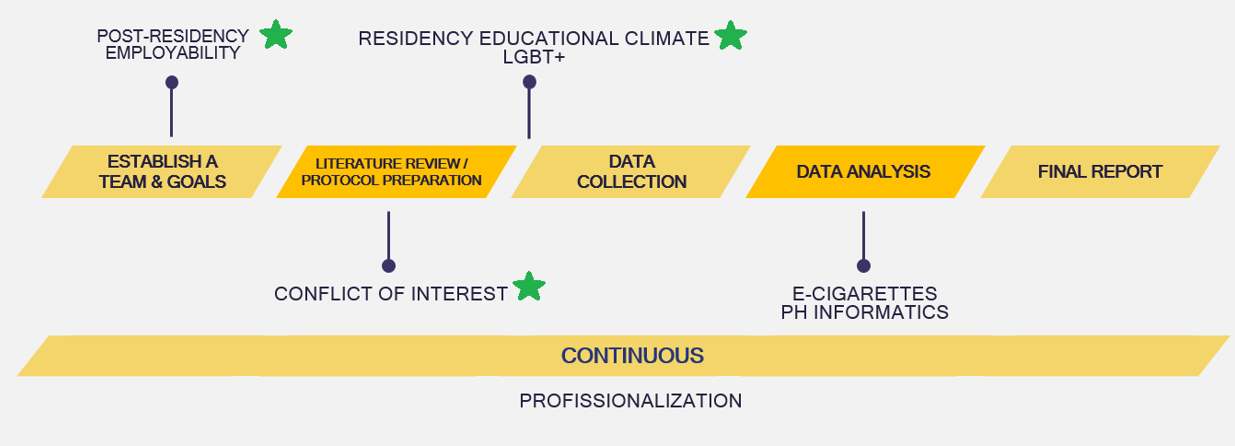
All working groups are in different stages of work (Figure 1), some still gathering a team, others piloting questionnaires, and the more advanced ones are analyzing the collected data. Three of the WG are still accepting new members to collaborate (marked with a green star in the figure).

Figure 1 – Working group stages.

During the past meeting, at Velika Planina, we organized one workshop where all WG were presented by their leads or co-leads. It was an important moment to exchange ideas and get some feedback on their ongoing work. To the new members it was explained how to join one WG or submit a new one. Together we did some brainstorming and concluded that one of the preferred topics for forming a new WG was “Influence of Politics on Health”.

The challenges and strengths of a WG are several, and were also discussed:

  • Work at international level:

– Cultural and linguistic barriers (we’ve learnt some of the difficulties and strategies to translate a questionnaire for example);

– Communication problems;

– Acquire motivation, teamwork and leadership skills;

– Be able to replicate a research in different countries;

– Learn more about health systems and PH residency in other countries;

  • Perform a research work:

– Ethical approvals have proved to be one of the biggest barrier to some groups;

– Time management and planification skills;

– Generate knowledge;

– Promote PH.

At the end, you can even end up presenting your work at a big conference, like Špela Vidovič did during the European Public Health (EPH) Conference in Ljubljana (Figure 2).

Don’t waste this opportunity and get more involved in this project. You can get more information about each WG on the website, or by sending an email to research@euronetmrph.org.

You can participate in a currently active WG or suggest a new one.

Gisela Leiras

Public Health resident, Portugal

EuroNet MRPH logo with the full name of the network, European Network of Multidisciplinary Residents in Public Health.

Conflict of interest between Professional Medical Societies and industry: a cross-sectional of the European Medical Societies’ websites

The relationship between industry and medical societies has been widely studied by the international literature and has been recognized as a potential condition for biases and conflicts of interest. A recent study analysed the relationship between industry and medical societies through the assessment of the Italian medical societies’ websites, finding some relevant correlations. Despite this scenario, little is known about the relationship between medical societies and industry in Europe.

The aim of the work conducted by Euronet MRPH is to extend the Italian research to seven European countries (Croatia, France, Ireland, the Netherlands, Portugal, Slovenia, and Spain). The study is important because it is a first such project addressing the conflict of interest between medical societies and industry in a comparative European setting. In addition to its scholarly contribution that will enhance the understanding of the nature of this relationship, the study has implications for the development of policy regulating the relationship between industry and medical societies, from disclosure requirements, to restriction on what industries can fund, among others. The working group already developed a structured flowchart to systematically produce comprehensive lists of all the medical societies in the included countries.
Up to date, a significant effort has been done in assessing the differences between the national definitions of medical societies and, so far, a heterogeneous framework emerged.

Stefano Guicciardi
Public Health Resident, Italy


EuroNet MRPH logo with the full name of the network, European Network of Multidisciplinary Residents in Public Health.

EuroNet MRPH working group LGBT well-being and work environment survey

The improved visibility of Lesbian, Gay, Bisexual, Trans and other non-heterosexual (LGBT+) people has not always been accompanied by advancements in the working and living conditions of those identifying as LGBT+. In medical residency programmes across Europe, there is little research analysing how challenges of the residency period align with the challenges associated with concealable identities and their disclosure. This paucity of data may be due to the notion that identity is inconsequential or irrelevant to achievement and well-being in medical studies and health professions.

EuroNet MRPH LGBT+ working group aims to better understand the daily living and working condition of medical residents identifying themselves as LGBT+. The product of this year of work (the project started in late 2016) is a questionnaire, made up of 45 questions, and organised in 6 sections, focusing on identities, acceptance both at work and home, episodes of discrimination or harassment, and emotional well-being. It will be soon disseminated after its translation in most of the languages spoken in the countries part of the network. The process of forward and backward translation will ensure semantic and conceptual equivalence between different versions and it will make data analysis reliable.

This project addresses the need for an informative survey about working environment experiences and well-being of medical residents identifying themselves as LGBT+, and could help to get an insight into the wider topic of LGBT+ acceptance in our health system. If you want to learn more or give a little help, do not hesitate to contact us.

Damiano Cerasuolo
Public Health Resident, France


EuroNet MRPH logo with the full name of the network, European Network of Multidisciplinary Residents in Public Health.

EuroNet MRPH Working Group on e-cigarettes and tobacco harm reduction: A research to assess competencies amongst Residents in Public Health

The fight against smoking is an international problem and, in many cases, it is far from being adequately implemented. An essential starting point to perform a comprehensive and accurate medical program for smoking cessation is the healthcare professionals’ awareness about smoking products and smokers’ habits. In fact, in the last years, customers have changed their behaviours and tastes, switching from consumption of normal cigarettes to electronic cigarettes (e-cigarettes) or other nicotine and tobacco products.1

Available literature shows that the actual healthcare professionals’ level of knowledge on this issue is sub-optimal, with likely negative implications on chances to help users to undertake cessation or harm-reduction pathways.2

Public Health workforce – current and future – has a major role to play here, as on the identification of better prevention policies and strategies. Hence, the idea underpinning this Working Group with EuroNet MRPH. This research comes from a proposal joint with Prof. Josep Maria Ramon Torrell of the University of Barcelona, Spain (Hospital Universitari de Bellvitge): with him, we designed the study protocol, with the aims to evaluate, through a European cross-sectional survey, the current level of knowledge about e-cigarettes and tobacco harm reduction strategy, and to highlight possible weaknesses in public health residency curricula in order to enhance Public Health Residents’ competences on these topics.

________________________

References

  1. Farsalinos KE, Romagna G, Tsiapras D, et al. Characteristics, Perceived Side Effects and Benefits of Electronic Cigarette Use: A Worldwide Survey of More than 19,000 Consumers. Int. J. Environ. Res. Public Health 2014;11:4356-4373. doi:10.3390/ijerph110404356
  2. Moysidou A, Farsalinos KE, Voudris V, et al. Knowledge and Perceptions about Nicotine, Nicotine Replacement Therapies and Electronic Cigarettes among Healthcare Professionals in Greece. Int J Environ Res Public Health. 2016;13:514. doi:10.3390/ijerph13050514

_________________________

Pietro Ferrara
Department of Experimental Medicine University of Campania “Luigi Vanvitelli”, Naples, Italy

EuroNet MRPH logo with the full name of the network, European Network of Multidisciplinary Residents in Public Health.

Multinational survey assessing learning climate and satisfaction during Public Health residency: an update from the Working Group

Learning climate has an important impact on knowledge and skills we acquire during residency. It encompasses many important aspects, such as the quality of supervision, professional relations between colleagues, quality of formal education and others. Numerous studies in the literature have sought to assess quality of training in different areas of medicine. However, in the area of public health training, there are no published studies on learning climate assessment or residents’ satisfaction during the residency.

The lack of literature in the area of assessing Public Health training inspired us to start a working group, which will perform a multinational study assessing learning climate and satisfaction during Public Health residency. The purpose of the study is to prepare the basis for evidence-based improvement of public health training in Europe.

Literature review was performed to identify tools currently used to evaluate learning climate during medical residency. Of all the questionnaires available, the working group chose D-RECT as the most applicable for our study. With author’s permission, we modified the questionnaire to suit Public Health residency. The new adapted questionnaire consists of 50 questions divided into 12 subscales. We proposed a new name for the modified questionnaire: European Residency Educational Climate Test (E-RECT).

The study will start after receiving the Ethics Committee approval. At this stage of the study, the questionnaire is being translated via a back-and-forth process into the language of each country. The piloting and validation process will follow, before we distribute the questionnaire  to all public health residents in each country.

The data obtained in the study will provide the opportunity to compare results between different countries and see what are the differences, the good practices and the opportunities to improve national residency programs. We encourage residents to respond to the invitation, when they receive it – fill in the online questionnaire to ensure that your voice is heard.

_________________________

Špela Vidovič
National Institute for Public Health, Slovenia

EuroNet MRPH logo with the full name of the network, European Network of Multidisciplinary Residents in Public Health.

Health and migration – A public health residents project

The 15th Conference of the Italian Society for Migration Medicine took place in Catania from April 18th to April 22th. The title was “Dynamics of health and migration: between continuity and new needs”. The conference program was rich in contents and stimuli, and was a multidisciplinary and multiprofessional platform to exchange practices, ideas and field experiences. It was an opportunity for health workers, researchers and academics, operators and educators working with immigrants, activists, volunteers and common citizens, to come together, reflect and learn about “the health of immigrants” and engage in its promotion and  protection.

The title of the conference encouraged to move beyond the “emergency approach”, which often leads to consider simply the emergency dimension of migration, while forgetting the 5 millions of immigrants that have been living and working for years in our country. It is necessary, on the contrary, to understand the “new needs” and move away from a debate centred on the emergency, as a starting point and an opportunity to rethink the organization of the whole health systems and models of care, towards a new definition of the concept of health, centred on PHC, on health promotion and on territorial and community dimensions, with attention to migration as well as to marginality and inequality.

Together with some residents in public health from different Italian universities, we created a working group on migration medicine to address the gaps we perceived in our knowledge on the subject. The group was established as a subgroup of the Inequality Working group of the Italian Hygiene Society Committee of Residents, in collaboration with the Regional Immigration and Health Groups (GrIS) of the Italian Society for Migration Medicine (SIMM). We share the belief that, as future public health professionals, we cannot afford to lack the competences which are necessary to face and interpret this phenomenon, which is central in the current Italian and global debate.

Asylum seekers are refugees who have left their country of origin and have applied for asylum. Italy recognizes and guarantees international protection and healthcare coverage for asylum seekers. The process to apply for and be granted a residence permit may require months, and in both phases they could potentially find themselves without healthcare coverage. Each region has its autonomy in the application of national protocols. This regional autonomy is associated with different waiting times for the acceptance and formalization of the request for international protection, and this leads to discrepancy and discretion in healthcare access for asylum seekers between their arrival and the formalization of the asylum application.

We are realizing a study that we presented at SIMM conference. We wanted to describe the policies (law, regulations…) of the different Italian regions and the gaps between policy and practice, and to map the different practices, in order to highlight similarities and differences. Our goal is to investigate any inequalities between protocols and daily practices, and to deepen our understanding of the issues related to the assistance paths activated immediately after the arrival of the asylum seekers. Preliminary results show differences among regions and single Local Health Units (LHUs) as well as fragmentation of the pathways of care following the first contact with the health system.

It would certainly be useful and interesting to extend the study outside of Italy, to the European context, thus including other countries. Migration must necessarily be read as a complex, interconnected and global issue, and consequently also the analysis of policies and practices can not be limited to a small geographical area.

In this, the quality and strength of the work, as well as the potential transformative power, would be positively affected by the possibility of creating a European network of resident students, who deal with the issue of migration medicine to compare approaches and identify new ways to interpret the complex reality we are trying to describe.

Through the history of Public Health, we have a duty to try to change the world for the better, because anything is possible if someone dreams about it.

_________________________

References

Società Italiana di Medicina delle Migrazioni – https://www.simmweb.it/

_________________________

Chiara Milani
Public Health Resident
University of Firenze
EuroNet MRPH logo with the full name of the network, European Network of Multidisciplinary Residents in Public Health.

Public Health Masters in the context of Public Health Resident Training in Europe

Nowadays, large disparities are still present among the different Public Health Masters (MPH) included in the training programmes of public health residents in Spain. Moreover, the impending changes in our training programme may result in a reduction of specific public health training for public health residents from four to two years, with the likely exclusion of MPHs as part of these changes.(1)

The Spanish Association of Residents in Preventive Medicine and Public Health (ARES MPSP) is concerned about these discrepancies and their consequences within the European context. Our aim was to characterize the disparities present among the different public health resident training programmes across the European Countries. A survey was developed to this end.

All members present at the Strasbourg meeting, representing eight of the nine countries that are part of EuroNet-MPRH, participated at the survey, which consisted in a single question “Is MPH a compulsory course part of the residency programme?”. Ireland, the remaining country, received the survey via email.

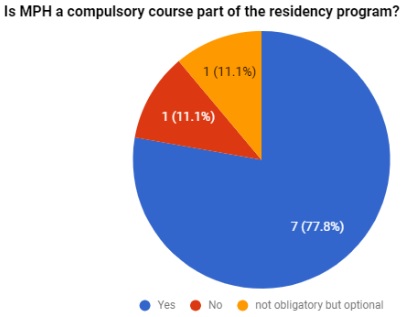
All countries, except Italy and Ireland, declared to have a MPH programme as part of their residency training programme. In Ireland, MPH is optional (See figure 1). Regarding commitment and time-dedication, 33%(3/9) of the surveyed countries reported the presence of part-time MPHs, while 44% (4/9) reported full-time commitment programmes.

Figure 1

Fees are more often covered by the employer then students, except in France, where trainees must sustain the fees by themselves. In three countries costs are covered by the ministry.

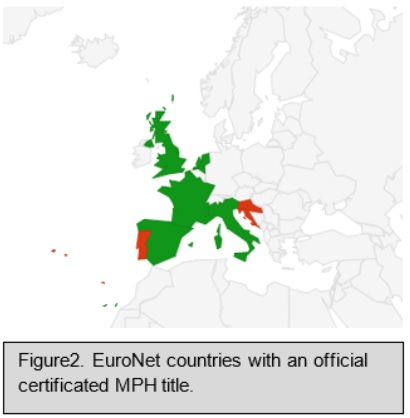
All countries except Portugal and Slovenia have an official MPH title. Although Croatia has an official MPH title, they are unsure about the accreditation status. Schools in Portugal are encouraged to consider MPH programmes as the academic part of a master programme, where students pay an extra fee to present a thesis and to obtain a degree. Slovenia hopes to have one in the future (See figure 2).

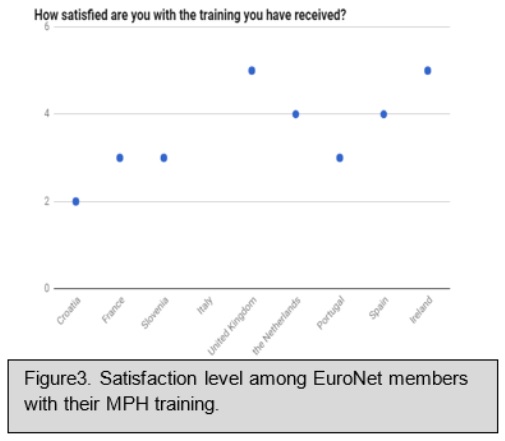
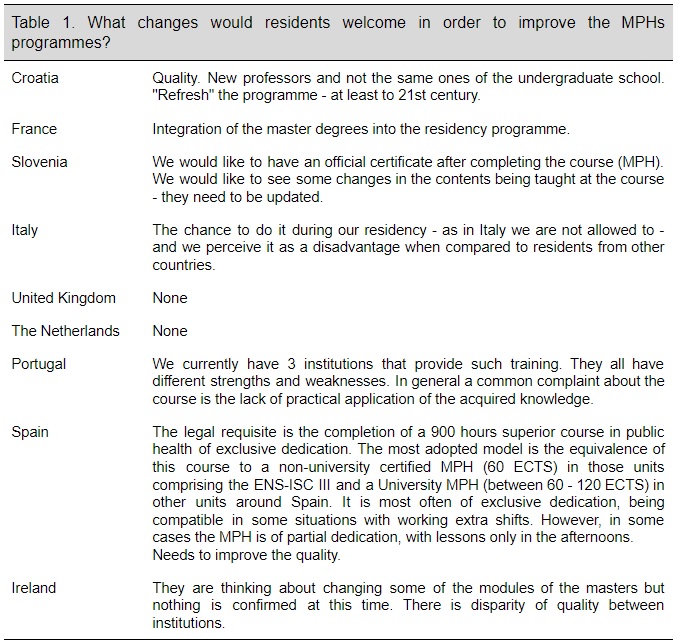
The residents satisfaction with the training received during the MPH was assessed with the question “How satisfied are you with the training you have received?”. The results show a median satisfaction of 3.5 points out of 5 [IQR: 2-5] (See figure 3).  Moreover, residents were asked about what kind of changes they would like to observe inside the MPHs programmes (Table 1).

As presented, there are great disparities among different MPH programmes across Europe. It would be desirable to further unify MPH criteria in order to increase training quality and mobility.

_________________________

References

  1.  Inamo J. et al. Existe-t-il des spécificités dans la prévalence et la prise en charge de l’hypertension artérielle aux Antilles-Guyane par rapport à la France métropolitaine ? BEH thématique, 16 décembre 2008 ; 49-50. Romon I. et al. Le poids important du diabète sur la mortalité dans les départements d’outre-mer. InVS, Mars 2007.
  2. Jaries R. et al. Population movements and the HIV cascade in recently diagnosed patients at the French Guiana -Suriname border., 2017; 13:1-5
  3. Carde E. Les discriminations selon l’origine dans l’accès aux soins. Access to health care and racial discrimination. Santé publique 2007, volume 19, n° 2, pp. 99-109.

_________________________

Fátima C. Mori Gamarra
Preventive Medicine and Public Health resident at Complexo Hospitalario Universitario de Ourense, Galicia – Spain

Julio Muñoz Miguel
Preventive Medicine and Public Health resident at Hospital Clínico Malvarrosa, Valencia – Spain

Adrían Aginagalde Llorente
Preventive Medicine and Public Health resident at Hospital Universitario de Cruces – Spain

(As published in EuroNews #13)

EuroNet MRPH logo with the full name of the network, European Network of Multidisciplinary Residents in Public Health.

EuroNet Platform crowdfunding campaign

The crowdfunding campaign to support the Platform Project is online and it will last until the end of the month of March.

The Platform is a unique network for European medical residents who have an interest in Public Health and want to create or participate to research projects.
By the means of the Platform, medical residents and trainees will be able to find or create work teams to develop their ideas. It is a great opportunity to let ideas come out and grow and to give free voice to young scientists.

You do not need to be a Public Health specialist or resident physician to want to get involved and support the campaign!
Even a little help means a lot for us and for this project!

Please, donate here: Wellfundr page.

Thank you!