EuroNet MRPH logo with the full name of the network, European Network of Multidisciplinary Residents in Public Health.

A crossroads for Public Health in Ireland: Slaintecare and proportionate universalism

This July the UK celebrated 70 years of the National Health Service which famously entitled healthcare to all “from cradle to grave”. Unfortunately progress on universal healthcare in the post-colonial Irish state has been much slower. In May 2017, a cross-party parliamentary committee produced a 10-year plan for the future of healthcare. Their report was called the “Sláintecare Report” (Sláinte translated from Irish means health) (1). It was ambitious with many recommendations including:

  1. The phasing out of private care in public hospitals
  2. Eliminate charges for access to public hospital care
  3. Reduce drug prescription charges
  4. Universal access to GP care without charge
  5. Expand public hospital capacity
  6. Reduce waiting lists for first outpatient department appointments and hospital treatment

However, progress on implementation has been slow and the signs are that the required funding will not be made available in the next budget. This is not the only barrier to implementation, doctors’ unions including the Irish Medical Organisation have come out against the plan to remove private medical practice from public hospitals (2).

This points to an important aspect within an Irish healthcare system which is the role of private healthcare. Figure 1 shows that amongst Euronet countries for which data is available from the OECD, Ireland has the highest per capita spend on healthcare and the highest spend on voluntary private health care and out of pocket payments (3).
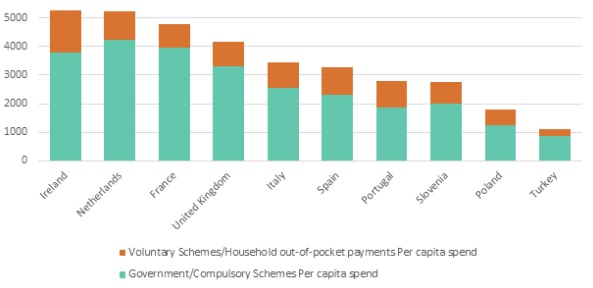
Figure 1. OECD data on per capita spending on health (all functions) of Euronet countries in 2016, based on current prices and current purchasing power parity in US dollars

The Whitehall Studies, led by Sir Michael Marmot, was a prospective cohort study of civil servants in the UK between 1967 and 1988 which examined the relationship between mortality and employment status. They demonstrated that even when controlled for lifestyle factors such as, smoking status, blood pressure, obesity and cholesterol, mortality rates followed a gradient from those of lowest status to those of highest status. For instance, those men in the lowest grade had a mortality rate three times that of the highest grade (4).

This result showing a social gradient in health outcomes has been replicated many times and the idea of “Proportionate Universalism” was coined by Sir Michael Marmot and proposed as a means of addressing this gradient of health inequalities in the “Marmot Review” (5). It describes public health interventions which are aimed at the entire population, universal, but which are proportionally weighted in favour of those in most need.

Proportionate Universalism has shown success in reducing health inequalities in the UK by addressing inequalities in healthcare provision and in the social determinants of health (6). However, it is not clear this means of addressing health inequalities would be sufficient to make a meaningful difference in an Irish context.

The continuum of health need in Ireland is not linear, with a major influence on this based on the marketization of healthcare within the system. Those who can afford Private Health Insurance have better access to hospital consultants and diagnostics, even within the public system (7). On top of this there are further financial barriers in out-of-pocket payments for primary care and prescriptions. Like Julian Tudor Hart described in his paper on the “Inverse Care Law”, those with most need have the least access to services (8).

The two tiered nature of the Irish healthcare system was encapsulated in the name of a book written 10 years ago on the subject called “Irish Apartheid”. If a Proportionate Universalism public health strategy is to be effective in Ireland we must follow the example of our European neighbours and move towards universal healthcare, oppose doctors who wish to protect their private practice and give our support to the spirit of Sláintecare.

_________________________

References 

  1. Shorthall R. Houses of the Oireachtas Committee on the Future of Healthcare Slaintecare Report. Houses of the Oireachtas: Oireachtas; 2017.
  2. Irish Medical Organisation. Irish Medical Organisation Submission to the Independent Review Group on Private Practice in Public Hospitals. Dublin: Irish Medical Organisation; 2018.
  3. Health expenditure and financing: Health expenditure indicators [Internet]. OECD Health Statistics  (database). 2018 [cited 29 July 2018]. Available from: https://www.oecd-ilibrary.org/content/data/data-00349-en.
  4. Marmot MG, Stansfeld S, Patel C, North F, Head J, White I, et al. Health inequalities among British civil servants: the Whitehall II study. The Lancet. 1991;337(8754):1387-93.
  5. Marmot M, Allen J, Goldblatt P, Boyce T, McNeish D, Grady M. Fair society, healthy lives. The Marmot Review. 2010;14.
  6. Egan M, Kearns A, Katikireddi SV, Curl A, Lawson K, Tannahill C. Proportionate universalism in practice? A quasi-experimental study (GoWell) of a UK neighbourhood renewal programme’s impact on health inequalities. Social Science & Medicine. 2016;152:41-9.
  7. Burke SA, Normand C, Barry S, Thomas S. From universal health insurance to universal healthcare? The shifting health policy landscape in Ireland since the economic crisis. Health policy. 2016;120(3):235-40.
  8. Hart JT. The inverse care law. The Lancet. 1971;297(7696):405-12.

_________________________

Christopher Carroll
Specialist Registrar in Public Health Medicine, Ireland

EuroNet MRPH logo with the full name of the network, European Network of Multidisciplinary Residents in Public Health.

Pertussis vaccination in pregnancy in Ireland

Between 2011-2017, pertussis notifications in Ireland were most commonly notified in infants and young children. The age specific incidence rate among the 0-5 month age group peaked in 2012 (ASIR 395/100,000) with smaller peaks in 2016 (235/100,000) and 2017 (225/100,000) Between 2012-2017, of all infant cases, 67% were hospitalised and several infant deaths due to pertussis were notified. None of the mothers of these fatal cases were vaccinated during pregnancy.

Vaccination of pregnant women has been shown to be safe and effective in preventing pertussis in infants. Evidence from data published in England1and Spain2 indicates that protection against pertussis is as high as 90% or more in infants whose mothers were vaccinated in pregnancy.

Antenatal care in Ireland is delivered in three ways: either private care through a maternity unity, free public care through a maternity unit or as free combined care between maternity units and general practitioners (GP). Since 2012, pertussis vaccination in pregnancy has been recommended in Ireland and is available free of charge to maternity units and general practitioners.

However, though the vaccine itself is free, all patients still incur a fee for administration. There is also no clarity or definition regarding where the vaccine should be administered, whether by a GP or in the maternity units. This is thought to contribute to the very low vaccine uptake seen. An audit of maternity units conducted in 2013 showed an uptake rate of 6.2% amongst pregnant women in Ireland. This is far lower than the uptake rate in the UK (73%) where pertussis vaccine is available to pregnant women free of charge.

The lack of a defined pathway for administration and full funding of pertussis vaccination in pregnancy represents a key barrier to increasing uptake. Clarifying a pathway of vaccine delivery and reimbursement should be a priority issue for the Irish health service to ensure that vulnerable infants are protected. Pertussis is a vaccine preventable disease and, as such, every effort should be made to prevent further infant morbidity and mortality.

_________________________

References

1 – https://www.ncbi.nlm.nih.gov/pubmed/25037990

2 – http://www.eurosurveillance.org/ViewArticle.aspx?ArticleId=22809

_________________________

Fiona Cianci
Specialist Registrar in Public Health Medicine
Department of Public Health, HSE East, Dublin (Ireland)

Telemedicine computer

Telemedicine and virtual healthcare in Ireland

While we wait for the new issue of the Newsletter in the making, we bring you an article from the last Euronet Newsletter, about “Telemedicine and virtual healthcare in Ireland”:

Virtual healthcare and telemedicine have burgeoned in Ireland in recent years, with many private companies offering online services including video General Practitioner  (GP) consultations, prescriptions for medications and home testing kits for sexually transmitted infections (STIs). As an example, there are now at least seven different online companies offering STIs testing to individuals in Ireland without the need to see a doctor or health worker. Some of these companies are based in Ireland, others are based in other countries such as the UK.

Health insurance companies have come on board and many now have contracts with online GP consultation services offering video consultations with one of these companies as part of their health insurance package.

So what are the implications for health and health care in Ireland from the advent of such companies? Certainly there are potential benefits to using online platforms in health and health care.

They have the potential to improve access to patients who live in rural or remote areas.  In the area of STIs testing they may increase testing and treatment of STIs particularly in young people. Telemedicine may increase the number of patients who can be seen and treated during a given period of time, important at a time when many GPs in Ireland are emigrating to other countries.

Virtual platforms have been used to improve communication and delivery of healthcare between services. In Ireland, a pilot programme between family doctors and hospital specialists involving an online forum for discussion and advice on cases has been used to reduce admissions to hospital.

However, this new and developing field raises many questions for health and healthcare. Because these are private companies, without an established relationship with patients, the loss of the central pillars of primary care that include continuity of care, the management of multi-morbidities, the doctor-patient relationship and the delivery of a holistic model of care are concerns. Testing for STIs through this system may also affect notification, contact tracing and sexual health promotion. Other questions arise; for example will rates of antibiotic prescribing increase, given that physical examination will not be possible in a video consultation for a respiratory tract infection?

There are many questions to be answered as to how the advent of such systems of delivering healthcare can affect health and healthcare in Ireland, both good and bad. It’s an opportunity for Public Health in Ireland to engage with the issue as it is likely that telemedicine and virtual healthcare will continue to expand both in Ireland and internationally.

Chantal Migone

EuroNet MRPH Ireland