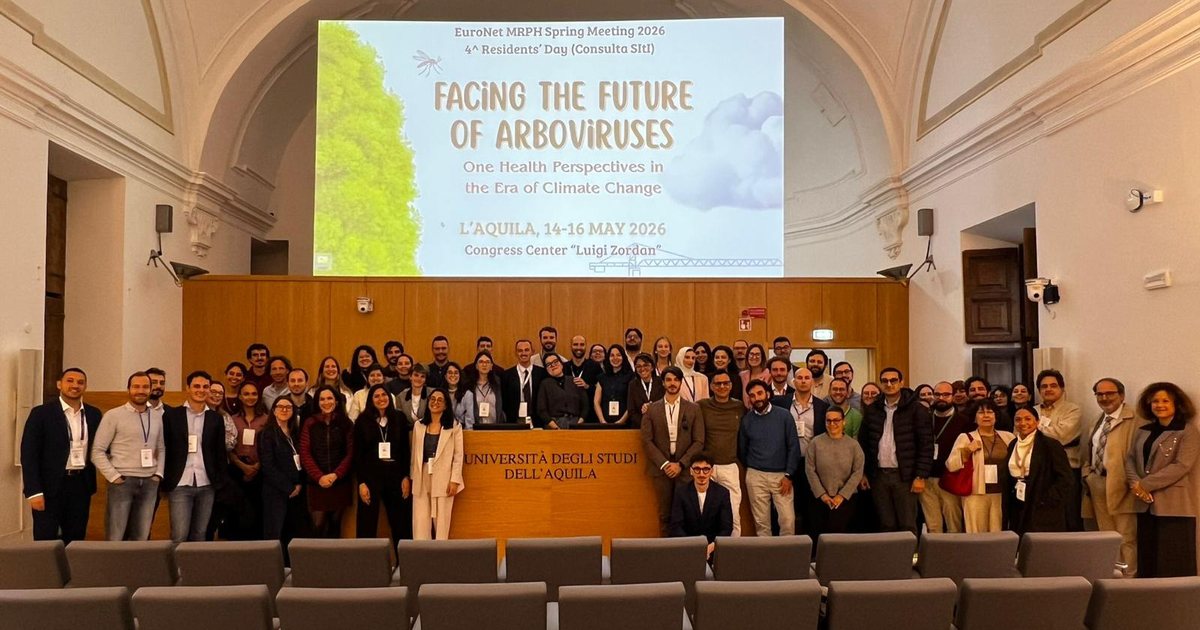
EuroNet MRPH residents at the 2026 Spring Meeting in L'Aquila, in front of the meeting banner.

Spring Meeting 2026 in L’Aquila: Facing the Future of Arboviruses

From 14 to 16 May 2026, EuroNet MRPH held its Spring Meeting in L’Aquila, 2026 Italian Capital of Culture, hosted by the University of L’Aquila at the “Luigi Zordan” Congress Center, jointly with the 4th Residents’ Day of the Consulta SItI, the Italian body of public health residents.

Poster of the EuroNet MRPH Spring Meeting 2026: Facing the Future of Arboviruses, One Health perspectives in the era of climate change. Congress Center Luigi Zordan, L'Aquila, 14 to 16 May 2026.

This year’s theme, “Facing the Future of Arboviruses: One Health Perspectives in the Era of Climate Change,” brought residents and experts together across human, animal and environmental health: the essence of a One Health approach to emerging threats.

A programme across three days

The scientific programme opened with Prof. Anna Odone (University of Pavia) on why arboviruses matter to public health, and ranged widely from there:

  • International cooperation and preparedness, and veterinary intelligence at the service of One Health (Experimental Zooprophylactic Institute of Abruzzo and Molise “G. Caporale”).
  • Genomic surveillance of emerging arboviruses and early warning in a warming world (Prof. Caterina Rizzo, University of Pisa).
  • The role of scientific communication in preparedness, and spatially-explicit modelling of invasive species under climate change (University of L’Aquila).
  • The urban-design dimension of One Health, travel in the era of climate change, and a front-line account of the Chikungunya outbreak in Carpi (Modena).

A record 19 abstracts, roughly double the previous year, competed in the European Scientific Contest, and the meeting hosted the EuroNet General Assembly (hybrid), the SItI Residents’ Committee meeting, and hands-on workshops turning evidence into public communication and advocacy.

Beyond the science, L’Aquila did what these meetings do best: it put residents from across Europe in the same room for three days. Conversations that start over coffee between sessions are how collaborations, exchanges and friendships across the network begin.

Our thanks to the Scientific Committee (Leila Fabiani, Elio Tolli), the Organising and Secretariat Committees, the University of L’Aquila, and the Consulta SItI, and to every resident who travelled to make it happen.

Full programme: download the PDF.

L'Aquila

Spring Meeting 2026 in L’Aquila: Call for Abstracts Now Open!

The EuroNet MRPH Spring Meeting 2026 will take place in L’Aquila, Italy on May 14–16! We invite you to save the dates for what promises to be an engaging scientific and cultural event.

The theme will be…

Facing the Future of Arboviruses

About the Venue

The meeting will take place in L’Aquila, a city located in the heart of the Apennines known for its stunning mountain views and lively university atmosphere.

L’Aquila is a city of resilience. Rebuilt with passion after the 2009 earthquake, it is now a hub of energy, culture, and creativity. As the designated Italian Capital of Culture for 2026, it provides the perfect backdrop to connect with colleagues and share ideas while discovering a unique European heritage.

Call for Abstracts: Now Open!

We invite early-career public health professionals, residents, and young researchers to submit abstracts on any topic related to Public Health. Research projects, reviews, innovative practices, and policy analyses are all welcome.

Submission deadline: 5 April 2026, 00:00 CET (extended through April 19!)

All selected abstracts will be presented as oral or poster presentations.

Logistics and Travel

While L’Aquila does not have its own airport, it is easily accessible via Rome:

  • Arrival: Fly into Roma Fiumicino or Roma Ciampino airports, or travel by train to Roma Tiburtina station.
  • Transfer: Direct buses run regularly from both airports and the train station to L’Aquila. The journey takes approximately 90 minutes.
  • Getting Around: Once you arrive in the city center, the venue and social activities are entirely walkable. You will not need additional transport during the event.

Stay Updated

This post will be updated as soon as the official program and registration details become available. To ensure you receive the latest announcements, we recommend subscribing to our channels:

We look forward to welcoming you to L’Aquila!

EuroNet MRPH logo with the full name of the network, European Network of Multidisciplinary Residents in Public Health.

Spring Meeting 2023 in Genoa: Health in a Changing World

Health in a changing world – Climate change and environmental emergency: from prevention to consequences

Genoa EuroNet Spring Meeting 2023

Record number of participants and immense success for The Annual Spring Meeting of EuroNet MRPH, which was held in Genoa from the 21 to the 23 June 2023.

More than 200 professionals of the world of Public Health came from all over Europe such as Italy, the Netherlands, Portugal, Spain, Norway, England, Croatia, France, Ireland and Turkey. This helped make this conference a global forum for discussion and exchange of ideas.

For the first time in Genoa, the event touched on crucial points in the current debate in the scientific world, hosting speakers and moderators of considerable cultural depth and experience.

The congress, titled “Health in a changing world – Climate change and environmental emergency: from prevention to consequences” addressed several issues with a One Health and Circular Health approach: climate change and the consequent modifications of the planet in which we live, the effects of pollution on ecosystems, the new frontiers of vaccinology and biotechnology, as well as the compelling need to effectively communicate the importance of global health care not only to policy makers and academia, but also and especially to the general public, in order to induce the empowerment necessary for change.

Plenary sessions, interactive workshops and panel discussions among experts enriched the event and were received with enthusiasm and interest by all participants.

A particularly significant aspect of this congress was the commitment to sustainable environment. The organization made sure that the event was completely eco-friendly, using recycled and recyclable materials. In addition, instead of distributing traditional gadgets, a project was initiated in collaboration with ZERO CO2, which led to the planting of trees in the Corniglia area of the Cinque Terre with the aim of cutting down carbon dioxide emissions.

This Initiative demonstrates the awareness and concrete actions in contributing to the mitigation of climate change.

Particular audience participation was registered in the interactive workshops, which put the spotlight on the health of the planet, mental health and eco-anxiety, climate change education, and the communication of health and science topics, and the European science contest, which awarded research and innovations from across Europe.

Among the prominent national and international speakers who spoke at the congress, it is only right to mention the presence of Professor Ilaria Capua, who gave a concluding speech on the topic of Circular Health that left the audience in the hall with many insights to ponder.

In conclusion, the EuroNet MRPH Annual Spring Meeting, organized by the School of Hygiene and Preventive Medicine in Genoa, played a key role in raising the alarm about climate change and in indicating the importance of immediate action to protect the health of people around the world.

With the input of internationally renowned experts, unforgettable events and strong environmental sustainability, this congress will remain in the memory of all participants as a pivotal moment in the struggle for a healthier and more sustainable future.

EuroNet MRPH logo with the full name of the network, European Network of Multidisciplinary Residents in Public Health.

A National Immunisation Information System in Italy

The Ministry of Health has recently established a National Immunisation Information System (IIS), through the Ministerial Decree of 17 September 2018 published in the Gazzetta Ufficiale n. 257/20181. The aim of the electronic registry is to facilitate estimation of vaccine coverage, monitor the nation-wide implementation of the National Immunisation Plan (NIP) throughout the national territory; and to provide information both to the international bodies and for administrative tasks.

The need to create a single IIS from 21 regional registers was agreed upon in the State-Regions Conference of 19 January 2017, and highlighted on the National Immunisation Plan 2017-20192. The Ministerial Decree of 17 September 2018 defines the information that all Italian regions and autonomous provinces must provide to the Ministry of Health, including:

1) vaccinated individuals;

2) individuals to be vaccinated;

3) subjects already immunised after natural infection;

4) subjects temporarily or permanently exempted for health reasons;

5) doses and timing of administrated vaccines.

The IIS should be linked to the national databases of communicable diseases and adverse events.

The national IIS will aggregate individual records from the regional registries and, through a more precise estimate of vaccination coverage, will improve the monitoring activities of the programs in place, and identify areas where extraordinary interventions are required. Furthermore, in order to maintain updated regional vaccine registries, the national IIS will make available to the Regions information related to citizens who will modify their residence. The Ministry of Health will have access only to anonymised information. The first upload of files from the regional authorities is expected by April 2019.

The last update of Italian regional IISs characteristics and functionalities are presented elsewhere3.


Vincenza Gianfredi

PH resident,  University of Perugia, Italy


References:

1. Ministero della Salute [Ministry of Health]. Decreto del Ministero della Salute: Istituzione dell’Anagrafe nazionale vaccini [Decree of Ministry of Health: Establishment of a National Immunisation Information System] 17 September 2018 published in the Gazzetta Ufficiale n. 257/2018

2. Ministero della Salute [Ministry of Health]. Piano Nazionale di Prevenzione Vaccinale 2017-2019 [National Plan of Vaccination Prevention 2017-2019]. 3 Apr 2018. Rome: Ministry of Health; 2018. Available from: http://www.salute.gov.it/imgs/C_17_pubblicazioni_2571_allegato.pdf

3. D’Ancona F, Gianfredi V, Riccardo F, Iannazzo S. Immunisation Registries at regional level in Italy and the roadmap for a future Italian National Registry. Ann Ig. 2018 Mar-Apr;30(2):77-85. doi: 10.7416/ai.2018.2199.

EuroNet MRPH logo with the full name of the network, European Network of Multidisciplinary Residents in Public Health.

Residency access in Italy: how did it change?

In Italy, procedures of application in medical residency have been deeply re-elaborated in the last four years. Until 2013, in order to pursue their own careers, young graduate doctors had to choose the University and the affiliated healthcare facility where they wanted to specialize, and take an entree exam there in these structures, through a local competition.

A first fundamental reform took place in 2014, when the introduction of a national competition replaced the hundreds of exams in the different Italian universities. Therefore, candidates were asked to individually choose up to six different branches of medicine, as well as to locate some preferred facilities; after the competition, the Ministry of Education, University and Research (MIUR) issued several national rankings, one for each medical specialization. The examination consisted of a multiple-choice test subdivided into a first general part identical for all, a second one based on three different macro-areas (medical area, surgical area, and area of health services), and a final ten-question test specific to different branches. In the following two years, residency access competitions remained almost unchanged.

Yet, the 2017 edition, albeit being structured along the lines of the previous ones, has been developed following a new regulation adopted by the MIUR on September 6th, with the purpose of streamlining and making the test procedures more transparent. Moreover, access to the different Schools of Specialization is now regulated by an annual national multiple-choice test. This test is the same for all students throughout the country, and it consists of 140 questions about key topics related to Medical School’s programmes, as well as some questions more specific to all the different medical branches.

A single national ranking including all the participants is then drafted based on the test’s scores. Starting from top of the list, each participant doctor who won a place as a resident is contacted in order to let him choose and declare both the preferred school of specialization and the selected city facilities. Each doctor is given the possibility of choosing up to three different kind of residencies, in order of preference. The achievement of high test scores allows to get a good ranking. The final score is calculated by summing the number of correct answers (that are worth 1 point each, while each wrong answer means losing 0.25 a point) to “extra-test” points, represented by University curriculum, which weighs definitely less than it used to in the previous tests ; in fact, now it is less than 7 points – rather than 15 – consisting of: up to 2 points for the degree grade, up to 3 points assigned after the weighted average of university exams’ grades, 0.5 a point per an experimental graduation thesis, and 1.5 points for a previous Ph.D.

Each annual edition of this new modality of residency access has to be specifically addressed by a competition notice published around the month of May.

In conclusion, this new national test was held last November, and, starting from December 4th, the awarded candidate doctors were able to choose the preferred available facilities, in a batch process depending on their score and rank position. The last residents’ allocation was held on December 22nd.

To those who have just started their training activities, all that remains for us to do is to wish you good luck, or if you prefer, buona fortuna!

More details at: MIUR, Italy – www.miur.gov.it

_________________________

Pietro Ferrara
Public Health Resident, University of Campania “L. Vanvitelli”, Naples, Italy

Viola Del Prete
Public Health Resident, University of Campania “L. Vanvitelli”, Naples, Italy

(As published in EuroNews #13)