EuroNet MRPH logo with the full name of the network, European Network of Multidisciplinary Residents in Public Health.

Working Groups Update

Research is one of the main projects of Euronet Medical Residents in Public Health (EuroNet MRPH) and its members represent an important part of the network workforce.

These groups constitute a great opportunity to develop disruptive works at an international level and allow the residents to work with colleagues from different European countries, and learn from their experience. The benefits you can take from participating in this unique and challenging work are unlimited.

Beside the working group established to provide the Association of Schools of Public Health in the European Region (ASPHER) with European residents’ feedback on the Professionalisation and Workforce Planning agenda, six research groups are currently active in the Network:

  • “Post-residency employability” led by Daniel Alvarez (ES);
  • “Conflict of interest” led by Stefano Guicciardi (IT);
  • “Residency educational climate” led by Špela Vidovič (SL);
  • “LGBT+ residents’ outness and work environment” led by Damiano Cerasuolo (FR);
  • “E-cigarettes” led by Pietro Ferrara (IT);
  • “Public Health informatics” led by Francesco D’Aloisio (IT).

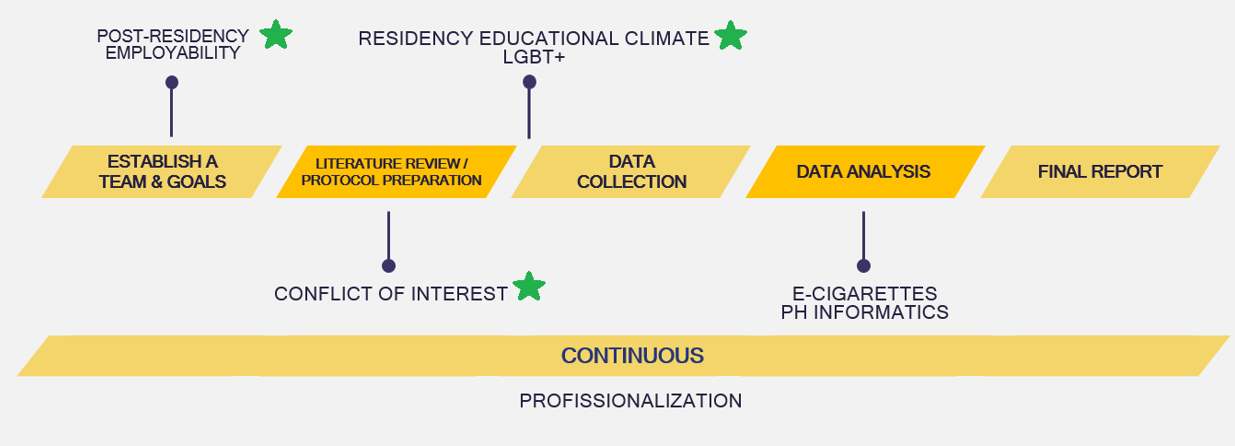
All working groups are in different stages of work (Figure 1), some still gathering a team, others piloting questionnaires, and the more advanced ones are analyzing the collected data. Three of the WG are still accepting new members to collaborate (marked with a green star in the figure).
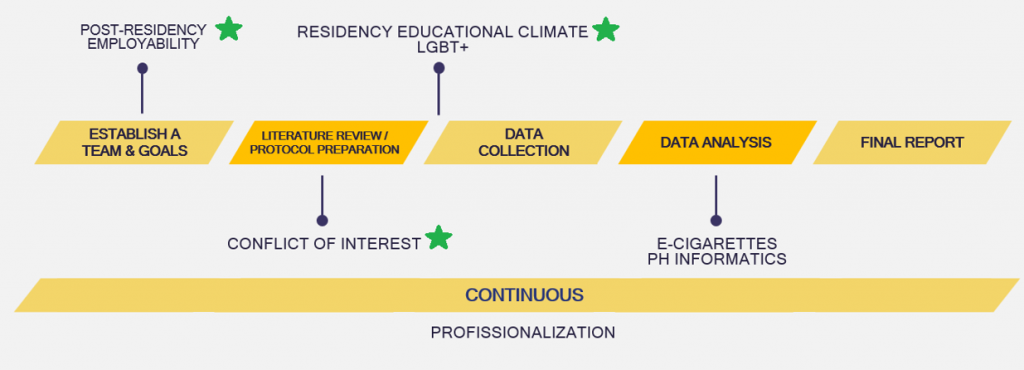
Figure 1 – Working group stages.

During the past meeting, at Velika Planina, we organized one workshop where all WG were presented by their leads or co-leads. It was an important moment to exchange ideas and get some feedback on their ongoing work. To the new members it was explained how to join one WG or submit a new one. Together we did some brainstorming and concluded that one of the preferred topics for forming a new WG was “Influence of Politics on Health”.

The challenges and strengths of a WG are several, and were also discussed:

  • Work at international level:

– Cultural and linguistic barriers (we’ve learnt some of the difficulties and strategies to translate a questionnaire for example);

– Communication problems;

– Acquire motivation, teamwork and leadership skills;

– Be able to replicate a research in different countries;

– Learn more about health systems and PH residency in other countries;

  • Perform a research work:

– Ethical approvals have proved to be one of the biggest barrier to some groups;

– Time management and planification skills;

– Generate knowledge;

– Promote PH.

At the end, you can even end up presenting your work at a big conference, like Špela Vidovič did during the European Public Health (EPH) Conference in Ljubljana (Figure 2).

Don’t waste this opportunity and get more involved in this project. You can get more information about each WG on the website, or by sending an email to research@euronetmrph.org.

You can participate in a currently active WG or suggest a new one.

Gisela Leiras

Public Health resident, Portugal
EuroNet MRPH logo with the full name of the network, European Network of Multidisciplinary Residents in Public Health.

EuroNet MRPH working group LGBT well-being and work environment survey

The improved visibility of Lesbian, Gay, Bisexual, Trans and other non-heterosexual (LGBT+) people has not always been accompanied by advancements in the working and living conditions of those identifying as LGBT+. In medical residency programmes across Europe, there is little research analysing how challenges of the residency period align with the challenges associated with concealable identities and their disclosure. This paucity of data may be due to the notion that identity is inconsequential or irrelevant to achievement and well-being in medical studies and health professions.

EuroNet MRPH LGBT+ working group aims to better understand the daily living and working condition of medical residents identifying themselves as LGBT+. The product of this year of work (the project started in late 2016) is a questionnaire, made up of 45 questions, and organised in 6 sections, focusing on identities, acceptance both at work and home, episodes of discrimination or harassment, and emotional well-being. It will be soon disseminated after its translation in most of the languages spoken in the countries part of the network. The process of forward and backward translation will ensure semantic and conceptual equivalence between different versions and it will make data analysis reliable.

This project addresses the need for an informative survey about working environment experiences and well-being of medical residents identifying themselves as LGBT+, and could help to get an insight into the wider topic of LGBT+ acceptance in our health system. If you want to learn more or give a little help, do not hesitate to contact us.

Damiano Cerasuolo
Public Health Resident, France


EuroNet MRPH logo with the full name of the network, European Network of Multidisciplinary Residents in Public Health.

EuroNet MRPH Working Group on e-cigarettes and tobacco harm reduction: A research to assess competencies amongst Residents in Public Health

The fight against smoking is an international problem and, in many cases, it is far from being adequately implemented. An essential starting point to perform a comprehensive and accurate medical program for smoking cessation is the healthcare professionals’ awareness about smoking products and smokers’ habits. In fact, in the last years, customers have changed their behaviours and tastes, switching from consumption of normal cigarettes to electronic cigarettes (e-cigarettes) or other nicotine and tobacco products.1

Available literature shows that the actual healthcare professionals’ level of knowledge on this issue is sub-optimal, with likely negative implications on chances to help users to undertake cessation or harm-reduction pathways.2

Public Health workforce – current and future – has a major role to play here, as on the identification of better prevention policies and strategies. Hence, the idea underpinning this Working Group with EuroNet MRPH. This research comes from a proposal joint with Prof. Josep Maria Ramon Torrell of the University of Barcelona, Spain (Hospital Universitari de Bellvitge): with him, we designed the study protocol, with the aims to evaluate, through a European cross-sectional survey, the current level of knowledge about e-cigarettes and tobacco harm reduction strategy, and to highlight possible weaknesses in public health residency curricula in order to enhance Public Health Residents’ competences on these topics.

________________________

References

  1. Farsalinos KE, Romagna G, Tsiapras D, et al. Characteristics, Perceived Side Effects and Benefits of Electronic Cigarette Use: A Worldwide Survey of More than 19,000 Consumers. Int. J. Environ. Res. Public Health 2014;11:4356-4373. doi:10.3390/ijerph110404356
  2. Moysidou A, Farsalinos KE, Voudris V, et al. Knowledge and Perceptions about Nicotine, Nicotine Replacement Therapies and Electronic Cigarettes among Healthcare Professionals in Greece. Int J Environ Res Public Health. 2016;13:514. doi:10.3390/ijerph13050514

_________________________

Pietro Ferrara
Department of Experimental Medicine University of Campania “Luigi Vanvitelli”, Naples, Italy

EuroNet MRPH logo with the full name of the network, European Network of Multidisciplinary Residents in Public Health.

Multinational survey assessing learning climate and satisfaction during Public Health residency: an update from the Working Group

Learning climate has an important impact on knowledge and skills we acquire during residency. It encompasses many important aspects, such as the quality of supervision, professional relations between colleagues, quality of formal education and others. Numerous studies in the literature have sought to assess quality of training in different areas of medicine. However, in the area of public health training, there are no published studies on learning climate assessment or residents’ satisfaction during the residency.

The lack of literature in the area of assessing Public Health training inspired us to start a working group, which will perform a multinational study assessing learning climate and satisfaction during Public Health residency. The purpose of the study is to prepare the basis for evidence-based improvement of public health training in Europe.

Literature review was performed to identify tools currently used to evaluate learning climate during medical residency. Of all the questionnaires available, the working group chose D-RECT as the most applicable for our study. With author’s permission, we modified the questionnaire to suit Public Health residency. The new adapted questionnaire consists of 50 questions divided into 12 subscales. We proposed a new name for the modified questionnaire: European Residency Educational Climate Test (E-RECT).

The study will start after receiving the Ethics Committee approval. At this stage of the study, the questionnaire is being translated via a back-and-forth process into the language of each country. The piloting and validation process will follow, before we distribute the questionnaire  to all public health residents in each country.

The data obtained in the study will provide the opportunity to compare results between different countries and see what are the differences, the good practices and the opportunities to improve national residency programs. We encourage residents to respond to the invitation, when they receive it – fill in the online questionnaire to ensure that your voice is heard.

_________________________

Špela Vidovič
National Institute for Public Health, Slovenia

EuroNet MRPH logo with the full name of the network, European Network of Multidisciplinary Residents in Public Health.

EuroNet Platform crowdfunding campaign

The crowdfunding campaign to support the Platform Project is online and it will last until the end of the month of March.

The Platform is a unique network for European medical residents who have an interest in Public Health and want to create or participate to research projects.
By the means of the Platform, medical residents and trainees will be able to find or create work teams to develop their ideas. It is a great opportunity to let ideas come out and grow and to give free voice to young scientists.

You do not need to be a Public Health specialist or resident physician to want to get involved and support the campaign!
Even a little help means a lot for us and for this project!

Please, donate here: Wellfundr page.

Thank you!

Binary file

Euronet 2.0

We will work together to develop a new website, more attractive for the people who want to know us and, also, for us.

Members of the working group :

  • Joris Muller (France, Webmaster)
  • Alexandre Quach (France)
  • Rachel Beanland(UK)
  • Guido Maringhini (Italy)
  • Laura Reques (Spain)