EuroNet MRPH logo with the full name of the network, European Network of Multidisciplinary Residents in Public Health.

The Ethical side of Public Health

Nowadays, we still deal with the ethical side of every public health program or initiative using concepts or ideas based on Kantianism or even Utilitarism. We overlight and quote Rose’s paradox(1), as if the population and the individual interests were the only ones that mattered on the difficult path of deciding whether a public health measure, law or policy must be implemented or not. We sometimes strive to achieve a middle point between the population’s best interest and the individual freedom. None of this is unfamiliar, however, the importance of public health as a tool to ensure the compliance of human rights is still rarely discussed.

“In the absence of action, human rights are mere words on paper”(2). This, is one of the most important critics to the human rights approach (the most common approach related to human development). It states that human rights must be associated to measures that assure to genuinely safeguard human development. Nevertheless, political agendas and public health policies around the globe do not actively direct their efforts to assure human development or human rights on the grounds that if freedom is guaranteed, human rights will be guaranteed.

No more than a year ago I met an amazingly intelligent, successful, and wonderful woman that explained to me that the human rights approach is not all. That public health is not only screening, mental health, surveillance, health promotion or Antonovsky’s view for health and illness. She explained that a theoretical negative freedom does not safeguard anything; that social justice could give more answers than questions, problems or debates. She recommended me a book in order for me to get the bigger picture, to be able to see with other eyes the ethical (or unethical) part of public health, to think public health. I’ve been reading and re-reading it ever since.

The capabilities approach (2,3) offers a list of indicators of human development. We could consider 10 central capabilities that may ensure human development (but there are other perspectives of the capabilities approach(3)). Central capabilities, or capabilities in general, are meant to be understood as a common doctrine to be considered in every policy, and more specifically in every public health policy.

Lots of public health programs focus on the power of informing the population, promoting health by every kind of activity imaginable or limiting access implicitly or explicitly to products understood as harmful. Some would define this road as a form of “desired welfarism” and not as a path to achieve human health or human development. Every piece of information, every activity, is full of ethical principles that could affect people’s preferences – and these people’s preferences affect the population’s health results. The Kantian’s idea of community of equals, the Adam Smith’s theory of the impartial spectator or even the Hampton assumption of how preferences should be examined, do not reflect that people’s preferences do not consider social justice. It is not possible to identify the preferences that are the result of unfair and hierarchical circumstances without an independent ethics theory that thinks carefully about social justice.

However, it is not my role to explain to you the theory, the book, or someone’s opinion. My goal is to make us all think and re-think, read and re-read, have another view for every initiative, program or plan. Let’s envision every project with another approach. Let’s try to make something meaningful.

_________________________

References

  1. Rose G. The strategy of preventive medicine. The strategy of preventive medicine. University Press; 1992.
  2. Nussbaum MC. Creating capabilities: the human development approach. Harvard University Press. 2011. 256 p.
  3. Sen A. Development as freedom. Oxford New. 2001. 366 p.

_________________________

Laura de la Torre Pérez
Public Health Resident
Servei de Medicina Preventiva i Epidemiologia – Hospital Clínic de Barcelona

EuroNet MRPH logo with the full name of the network, European Network of Multidisciplinary Residents in Public Health.

Environmental Health – climate change and impact

Climate change is not a new issue in global agenda, as well as environmental adverse effects on health. Climate consequences are not limited to low and middle-income countries, and Europe will not be spared in such global threat. It is expected that climate change will cause over 250000 additional deaths per year between 2030 and 2050. (1) Globally it is urgent to include a new ecological public health attitude, in which sustainability becomes part of daily practice. (2) Quality evidence is required to mitigate through inclusive strategies undeniable climate outcomes. One health through a cohesive concept, addresses environment and human health sinergically with animal welfare and veterinary medicine. By moderating consequences through multiple tactics, it is possible to achieve objectives in their whole dimension. (3)

Besides total environmental related deaths have been constant, in the last decades a shift from infectious diseases to non-communicable diseases was seen both in environmental fraction and burden, translating years of development in water safety and sanitation in low and middle-income countries. By estimating burden of disease that can be attributable to environmental risks, we can predict how measures can have impact on safeguarding people’s health – population attributable fraction. The acknowledgment of which factors can be amendable is crucial to support evidence in order to locate resources in actions that have a quantifiable benefit. (4) (5)

To monitor these changes, a surveillance system that include both ecological and human health impacts is essential. It is not possible to address these issues without giving health systems an essential role on moderating climate impact on populations’ health and societies. By decreasing their not minor footprint, the sector can be an example that transformations are accessible to all, even in segments as complex as health systems. Second and more appealing to managers and business associates is that these changes can have a serious impact on systems budgets and expenses.

Remarkably, health sector can improve public health and reduce costs simultaneously. (6)

_________________________

References

  1. Hales, S, et al. Quantitative risk assessment of the effects of climate change on selected causes of death, 2030s and 2050s. Geneva : World Health Organization, 2014. ISBN 978 92 4 150769 1.
  2. Brousselle, Astrid e Butzbach, Camille. Redesigning public health for planetary health. The Lancet Planetary Health. May 2018, Vols. 2, Issue 5 , e188 – e189.
  3. One Health Initiative. One Health Initiative. About One Health. [Online] [Citação: 3 de May de 2018.] http://www.onehealthinitiative.com/about.php.
  4. Prüss-Ustün, A, et al. Preventing disease through healthy environments: A global assessment of the burden of disease from environmental risks. s.l. : World Health Organization, 2016.
  5. World Health Organization. Preventing noncommunicable diseases (NCDs) by reducing environmental risk factors. Geneva : s.n., 2017 (WHO/FWC/EPE/17.1). Licence: CC BY-NC-SA 3.0 IGO.
  6. WHO’s Department of Public Health and Environment and Health Care Without Harm. Healthy Hospitals – Healthy Planet – Healthy People | Addressing climate change in health care settings – discussion draft . s.l. : World Health Organization, 2008.

_________________________

Mariana Perez Duque
Public Health Resident
Public Health Unit ACeS Porto Ocidental, ARS Norte, Portugal

EuroNet MRPH logo with the full name of the network, European Network of Multidisciplinary Residents in Public Health.

The Turkish association of residents in Public Health joins EuroNet MRPH

During the Summer Meeting in Valencia, Turkey joined EuroNet MRPH. With a population of more than 80 millions people, Turkey is one of the biggest countries of the European continent. In this country Public Health is listed as a clinical discipline and it has several challenges to face. It is expected that around 2400 public health specialist will be needed in 2023 to answer to the Turkish population’s needs*.

EuroNetters are extremely happy to welcome their Turkish colleagues and are looking forward to meeting them all as soon as possible. The road for a better “health for all” is still long, but together we are stronger!

Please, find attached to this post the presentation of Turkish residency programme. More information will be soon updated on the website.

Public Health Residency Turkey


*http://dergipark.gov.tr/download/article-file/152999

EuroNet MRPH logo with the full name of the network, European Network of Multidisciplinary Residents in Public Health.

A road map for professionalisation: the ASPHER/WHO/CoP meeting at the Imperial College of London

In mid-June, we had the opportunity to strengthen once again our partnership with ASPHER.
As you may know, EuroNet has been working with ASPHER and the WHO on the professionalisation of the public health workforce. This project has three main areas of work:
· The Professionalisation Road Map
· The Competencies framework
· The Accreditation work
A Working Group led by Jo McCarthy has been giving opinion and advice on the first two areas of work.
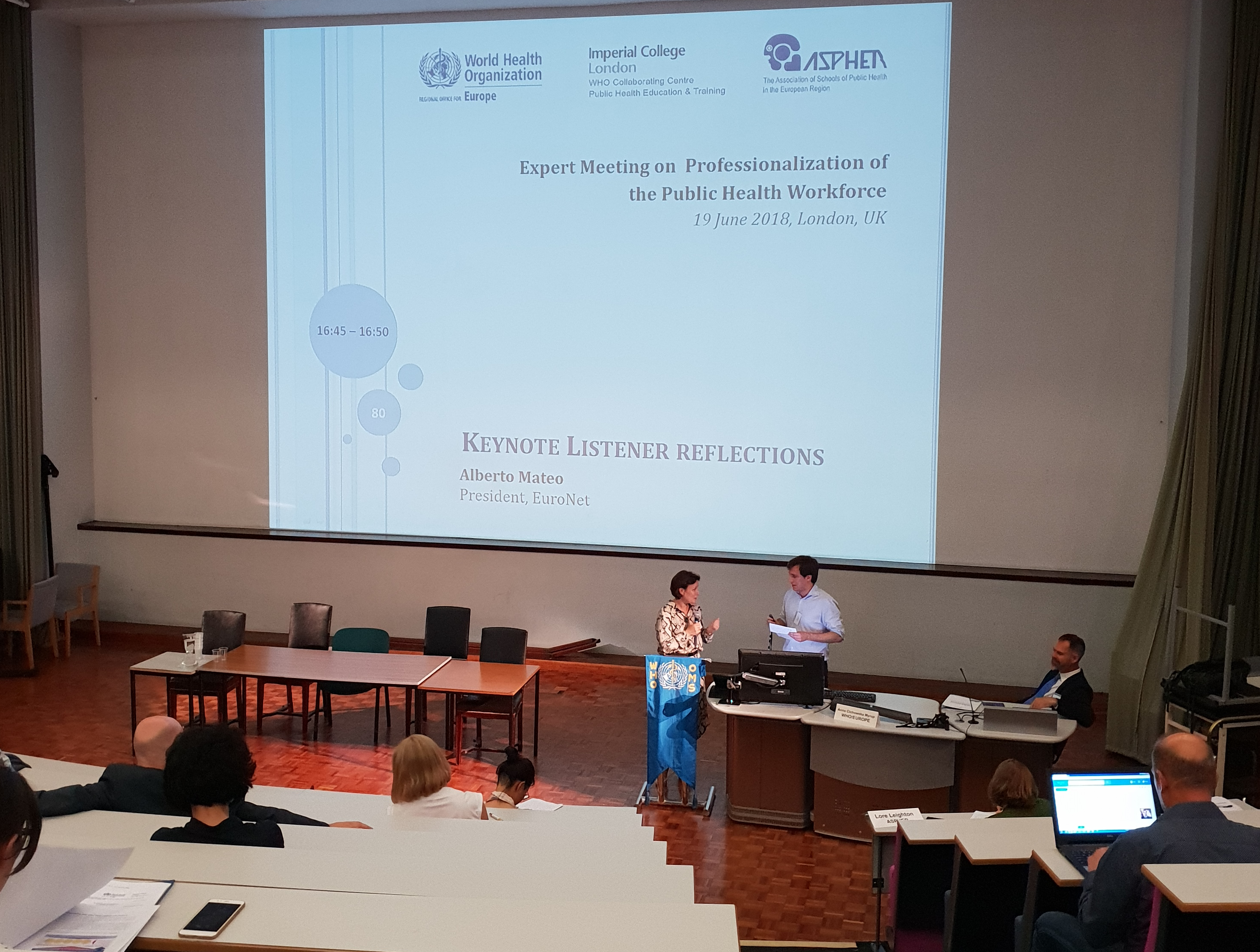
As a key stakeholder, EuroNet was invited to the expert meeting held on the 19th of June in London. In there, different experts and stakeholders from across Europe discussed the way in which the public health workforce can achieve the same degree of professionalization than other medical specialties. We also discussed the common framework of competences that a public health professional should achieve and what would the accreditation process.
Three Euroneters (Damiano, Damir and Alberto) participated in the key discussions led by ASPHER and WHO senior public health professionals, such as Katarzyna Czabanowska, Anna Chichowska or Jose María Martín Moreno. It was a very productive meeting in which we were strengthened our commitment with this project.
Alberto had the opportunity to share his insights as a key note listener at the end of the day. Also, Damir Ivankovic, as a member of ASPHER’s executive board, stayed in London for the rest of the week participating in the ASPHER retreat.
As usual, we used our visit to London to visit euroneters around the world. In this case, we had the opportunity to visit Diogo, from Portugal; and to share stories, views and public health opinions whilst enjoying a pizza in central London.

EuroNet MRPH logo with the full name of the network, European Network of Multidisciplinary Residents in Public Health.

Promoting Public Health – EuroNet workshop in Catania

On Friday the 15th of June, we had the opportunity to present a workshop at the “Giornate degli Specializzandi di Igiene e Medicina Preventiva”. This is an annual congress that brings together all the public health residents in Italy. This year it took place in the beautiful city of Catania, Sicily.
The workshop was organised on the second day of the congress. Alberto, EuroNet’s president, and Spela, E-RECT’s working group lead, presented the session. During the workshop, both euroneters described the network to our Italian colleagues, as well as the work that we do in relation to improving the public health training programmes in Europe.
After a couple of short presentations, the Italian residents were divided in groups and asked to give their opinion about how public health could be promoted as a popular specialty among medical students; and about the good and not so good aspects of their residency programmes. Their responses were discussed and collected, so that they can inform future work of the network.
The workshop proved to be popular, generating useful discussions which prove the importance of the topic.
We were also able to see old euroneters who we hope to see soon and to meet new residents, some of which have been gifted with EuroNet’s party spirit (to be continued in Valencia). We really enjoyed the Sicilian hospitality, which included a large amount of aubergines and late parties.
We want to thank specially Robin Thomas, who was “in charge” of us. He really did a fantastic job and we are very grateful to him.
We hope this is only the beginning of EuroNet’s involvement in national events such as this one. By being present in this type of congresses, we ensure that our work is aligned with the interests of public health residents across all European countries.
Once again, grazie per tutto EuroNet Italy!

EuroNet MRPH logo with the full name of the network, European Network of Multidisciplinary Residents in Public Health.

“FUNI” Workshop

Thanks to our Italian members, EuroNet has been given the opportunity to organise a workshop at the Giornate degli Specializzandi in Igiene e Medicina Preventiva, which will take place on the 15th of June in the beautiful city of Catania.


Our president Alberto Mateo and E-RECT’s WG lead Špela Vidovič will lead the workshop, titled “FUNI” (Facilitating residents’ mobility, Undertaking research, Networking, Improving residency programmes). For one hour and a half, they will lead a discussion on how training programmes work across Europe; what the strengths and weaknesses of each programme are; how we can improve them and what EuroNet is already doing.
The workshop will be a fantastic opportunity to present and promote our network, as well as some of the work that we are doing, particularly in relation to the E-RECT study and the Professionalisation Working Group.
Our Italian members will be facilitating the workshop, making sure it is a success. They will also be in charge of showing the city to Alberto and Špela, as well as making sure they try some of the finest Sicilian food and wine. Pictures and report will follow the workshop. So, stay tuned!

EuroNet MRPH logo with the full name of the network, European Network of Multidisciplinary Residents in Public Health.

Residency access in Italy: how did it change?

In Italy, procedures of application in medical residency have been deeply re-elaborated in the last four years. Until 2013, in order to pursue their own careers, young graduate doctors had to choose the University and the affiliated healthcare facility where they wanted to specialize, and take an entree exam there in these structures, through a local competition.

A first fundamental reform took place in 2014, when the introduction of a national competition replaced the hundreds of exams in the different Italian universities. Therefore, candidates were asked to individually choose up to six different branches of medicine, as well as to locate some preferred facilities; after the competition, the Ministry of Education, University and Research (MIUR) issued several national rankings, one for each medical specialization. The examination consisted of a multiple-choice test subdivided into a first general part identical for all, a second one based on three different macro-areas (medical area, surgical area, and area of health services), and a final ten-question test specific to different branches. In the following two years, residency access competitions remained almost unchanged.

Yet, the 2017 edition, albeit being structured along the lines of the previous ones, has been developed following a new regulation adopted by the MIUR on September 6th, with the purpose of streamlining and making the test procedures more transparent. Moreover, access to the different Schools of Specialization is now regulated by an annual national multiple-choice test. This test is the same for all students throughout the country, and it consists of 140 questions about key topics related to Medical School’s programmes, as well as some questions more specific to all the different medical branches.

A single national ranking including all the participants is then drafted based on the test’s scores. Starting from top of the list, each participant doctor who won a place as a resident is contacted in order to let him choose and declare both the preferred school of specialization and the selected city facilities. Each doctor is given the possibility of choosing up to three different kind of residencies, in order of preference. The achievement of high test scores allows to get a good ranking. The final score is calculated by summing the number of correct answers (that are worth 1 point each, while each wrong answer means losing 0.25 a point) to “extra-test” points, represented by University curriculum, which weighs definitely less than it used to in the previous tests ; in fact, now it is less than 7 points – rather than 15 – consisting of: up to 2 points for the degree grade, up to 3 points assigned after the weighted average of university exams’ grades, 0.5 a point per an experimental graduation thesis, and 1.5 points for a previous Ph.D.

Each annual edition of this new modality of residency access has to be specifically addressed by a competition notice published around the month of May.

In conclusion, this new national test was held last November, and, starting from December 4th, the awarded candidate doctors were able to choose the preferred available facilities, in a batch process depending on their score and rank position. The last residents’ allocation was held on December 22nd.

To those who have just started their training activities, all that remains for us to do is to wish you good luck, or if you prefer, buona fortuna!

More details at: MIUR, Italy – www.miur.gov.it

_________________________

Pietro Ferrara
Public Health Resident, University of Campania “L. Vanvitelli”, Naples, Italy

Viola Del Prete
Public Health Resident, University of Campania “L. Vanvitelli”, Naples, Italy

(As published in EuroNews #13)

EuroNet MRPH logo with the full name of the network, European Network of Multidisciplinary Residents in Public Health.

Public Health Residency: Time for Focus and Opportunity

Last  January, I started my residency in Public Health in Oporto, at an institution responsible for all the population living or working in the oriental area of the city. I’m very pleased with my choice and I feel very welcomed by this big community. Fortunately, public health in Portugal is on the rise in the last 8 years with an increase number of all public health professionals. Even in Europe and all around the world, public health is becoming more prominent in order to have real impact in our lives and on the ones in most need. Euronet is an excellent example of the ambition and hard work of a new technological generation of public health doctors, understanding the value of a solid and robust network between different countries and cultures. One of my first goals, after choosing public health as my profession, was to find out what it is and its objectives. Besides its fundamental actions according to WHO, promoting health, preventing disease and prolonging life, and the additional ten major interventions that we can and should address on a daily basis, I read a sentence stated by Arnaldo Sampaio, a reference figure in the development of public health in Portugal, that, in my opinion, describes the range that public health can have, “If you want you can even consider the public lighting as a promoter of better Public Health, since it gives more safety to pedestrians and decreases the probability of road accidents”.

In the first residence year our program in Portugal is focused on community health. A major aim of this phase is to learn and practice epidemiological surveillance and intervention. In Oporto, we work with a population that has a big incidence of tuberculosis comparing with other regions of Portugal. It is characterized for having a low socioeconomic status and poor neighborhoods, and consequently low hygienic conditions and reduced search of healthcare treatment in due time, which are risk factors for acquiring the disease. Those conditions promote the spread of the disease between family, friends and work colleagues. Although our job’s aim is towards the identification of the source of the disease and all the contacts, there are, unfortunately, some barriers and bureaucratic restrictions that not allow us to do it properly. For example, the minimum 6 month period of treatment of tuberculosis is a huge downsize in the battle against the disease, since some cases doesn’t even complete the treatment, despite its mandatory order to do it under observation. One suggestion to fight those problems could be health institutions merely for treating tuberculosis where patients could be hospitalized during it, depending on the danger to themselves or others. We have the ability to, if not eradicate, reduce considerably the incidence of tuberculosis with new and good practices, using all the information that we have available today.

In almost two months I proudly declare that public health is exceeding my expectations, that I feel highly motivated and we all should encourage each other in order to overcome all the barriers that we might face along our path. Public health gives us all the tools to make a better, healthier and more sustainable world. Together, and perhaps with Euronet and its communication assets, we can make the difference.

_________________________

João Paulo Magalhães
MD, Public Health Resident, Portugal

(As published in EuroNews #13)