EuroNet MRPH logo with the full name of the network, European Network of Multidisciplinary Residents in Public Health.

Perspectives: Public Health Workforce Development in Slovenia and Wider

Introduction

History of modern society is riddled with public health breakthroughs. Advances based on the notion of prevention of disease and promotion of good health allowed for better living conditions, safe transportation, diverse and nourishing diets, and numerous other standards of developed societies most of us take for granted.

In retrospect, we praise much of those advances as prototypal public health measures. Did ingenious minds behind those actions perceive themselves as public health pioneers? One might even argue that they needn’t identify as such (1). John Snow, Louis Pasteur and Robert Koch transformed the world through their work and for that they only had to subscribe to the ideal of public health – not to the profession. They were inventors that spawned a health revolution. But times have changed. We are faced with globalised world, global warming and regular political tantrums with possibly perilous consequences (2). Nations of the world are putting health high on the agenda with concerted actions such as Millennium Development Goals and Sustainable Development Goals (3). Further advancement of public health demands a different toolset and approaches from those of past eras. This holds true for public health practice on international as well as on an national or even local level (4). Modern challenges of public health require a workforce with capacities to address and overcome them (5,6). Public health practitioners of today and tomorrow need to be leaders as much as scientists and inventors (7). Development of such a workforce is the common theme of following reflections provided by a group of professionals with deep insight into education and training practices in public health.

The collection of reflections starts with an overview of current status and recent initiatives in public health workforce development in the European region written by Robert Otok, Katarzyna Czabanowska, and John Middleton who are all active in Association of Schools of Public Health in the European Region, a key independent European organisation dedicated to strengthening the role of public health by improving education and training of public health professionals for both practice and research.

Alberto Mateo, president of the European Network of Medical Residents in Public Health, further reflects on the topic of international cooperation and on importance of internationally harmonised curricula in public health education. Afterwards authors focus on analysing and reflecting on public health workforce development in Slovenia. Tit Albreht from National Institute of Public Health addresses the challenge of diversification of public health workforce in Slovenia. In his commentary, he stresses the importance of standard education as well as continuous professional development. Recognising the importance of having a modern and comprehensive public health educational programme for medical residents, Lijana Zaletel Kragelj from Faculty of Medicine at University of Ljubljana provides us with a summary of the transformation of Slovenian public health specialty training programme from its conception and offers us with a glimpse of what we can expect in near future. Ivan Eržen from National Institute of Public Health completes the overview of graduate and postgraduate programmes which offer public health topics in their curriculums. Acknowledging the limitations of current landscape of educational opportunities in public health he points out the need for a school of public health which has yet to be established in Slovenia. In the following commentary, Marjan Premik, one of the main protagonists of establishment of school of public health in Slovenia, introduces arguments for school of public health as an integral part of health care system. Putting the emphasis on the wider public health workforce, Mitja Vrdelja from National Institute of Public Health, gives his view on working in public health in Slovenia from a communications expert perspective and complements reflections on workforce developments from previous authors with challenges that could be solved with appropriate education and training of public health workforce. Current Perspectives are rounded up with a playful note by a discussion I had with Damir Ivanković, a former public health resident from Croatia who is presently a researcher at the Academic Medical Center in Amsterdam. Since both of us are a young public health professionals from relatively small countries we take a look at benefits and drawbacks of starting a career in such an environment.

Matej Vinko
National Institute of Public Health of Slovenia, Ljubljana, Slovenia

Keep reading the article at:
http://www.nijz.si/sites/www.nijz.si/files/uploaded/vinko_jz_03-06.pdf

References

  1. Nijhuis HG, van der Maesen LJ. The philosophical foundations of public health: an invitation to debate. J Epidemiol Community Health. februar 1994.;48(1):1–3.
  2. Lomazzi M, Jenkins C, Borisch B. Global public health today: connecting the dots. Glob Health Action. 2016.;9:28772.
  3. Sachs JD. From Millennium Development Goals to Sustainable Development Goals. The Lancet. 9. junij 2012.;379(9832):2206–11.
  4. Birt CA, Foldspang A, Otok R. Meeting the population health challenge: what should you know, and what should you be able to do? Eur J Public Health. oktober 2018.;28(5):789–90.
  5. Bjegovic-Mikanovic V, Foldspang A, Jakubowski E, Müller-Nordhorn J, Otok R, Stjernberg L. Developing the public health workforce. Eurohealth Inc Eur Obs. 2015.;21(1):24–7.
  6. Collyer TA. Three Metaphors to Aid Interdisciplinary Dialogue in Public Health. Am J Public Health. 25. september 2018.;e1–4.
  7. Czabanowska K, Rethmeier KA, Lueddeke G, Smith T, Malho A, Otok R, in sod. Public health in the 21st century: working differently means leading and learning differently. Eur J Public Health. december 2014.;24(6):1047–52.

As published in Revija Javno zdravje
EuroNet MRPH logo with the full name of the network, European Network of Multidisciplinary Residents in Public Health.

Service sanitaire: a first step towards the decompartmentalisation of the French health system?

In September 2018, more than 45 thousand French health students will be involved in the “sanitary service” (service sanitaire). This program has been launched by the French government in January 2018 and it concerns medical, dental, nursing, physiotherapy, and midwifery students; all other health students will be involved from 2019 on. The objective is to train them in prevention and health education, competencies that are now missing from most health training curricula, through the elaboration an implementation of a practical project to the benefit of the population.

The sanitary service responds to the first axe of the national health strategy 2018-2022, which is to develop a prevention and health promotion policy. Throughout three weeks, the students will be trained in public health, project management, prevention, health promotion and they will then have three weeks of hands-on experience in a interdisciplinary team. They will be supported by a pedagogic referent (référent pédagogique) from their university and a proximity referent (référent de proximité) from the structure where they will intervene. The places of intervention will mostly be middle and high schools, but also retirement houses and structures managed by social services.

The biggest challenge for universities, at one month from the beginning of the program, is to provide a quality training and support to the students, in order to respond to the expectations and needs of the structures where they will intervene, the population and the students themselves.

Sources (in French) :

_________________________

Maria Francesca Manca
Public Health Resident, France

EuroNet MRPH logo with the full name of the network, European Network of Multidisciplinary Residents in Public Health.

Multinational survey assessing learning climate and satisfaction during Public Health residency: an update from the Working Group

Learning climate has an important impact on knowledge and skills we acquire during residency. It encompasses many important aspects, such as the quality of supervision, professional relations between colleagues, quality of formal education and others. Numerous studies in the literature have sought to assess quality of training in different areas of medicine. However, in the area of public health training, there are no published studies on learning climate assessment or residents’ satisfaction during the residency.

The lack of literature in the area of assessing Public Health training inspired us to start a working group, which will perform a multinational study assessing learning climate and satisfaction during Public Health residency. The purpose of the study is to prepare the basis for evidence-based improvement of public health training in Europe.

Literature review was performed to identify tools currently used to evaluate learning climate during medical residency. Of all the questionnaires available, the working group chose D-RECT as the most applicable for our study. With author’s permission, we modified the questionnaire to suit Public Health residency. The new adapted questionnaire consists of 50 questions divided into 12 subscales. We proposed a new name for the modified questionnaire: European Residency Educational Climate Test (E-RECT).

The study will start after receiving the Ethics Committee approval. At this stage of the study, the questionnaire is being translated via a back-and-forth process into the language of each country. The piloting and validation process will follow, before we distribute the questionnaire  to all public health residents in each country.

The data obtained in the study will provide the opportunity to compare results between different countries and see what are the differences, the good practices and the opportunities to improve national residency programs. We encourage residents to respond to the invitation, when they receive it – fill in the online questionnaire to ensure that your voice is heard.

_________________________

Špela Vidovič
National Institute for Public Health, Slovenia

EuroNet MRPH logo with the full name of the network, European Network of Multidisciplinary Residents in Public Health.

Reflections of a Public Health Resident

I’ve been an internal Public Health doctor since January, and I’m taking my first steps in the wide-ranging medical specialty of Public Health. My unit of work covers a wide area including two small-sized cities, Santa Maria da Feira and Arouca, located approximately 40 kms south of Porto. As the first year of an internship in Portugal is focused on Community Health, my daily work is based on 5 major areas: Prevention and Health Promotion, Environmental Health, Health Authority, Epidemiological Surveillance and Health Planning.

In addition to having a particular interest in Global Health, I attend traveller’s consultations in the International Vaccination Center of Porto whenever I possibly can. I grasped the opportunity to attend the World Health Summit Regional Meeting, which took place in Coimbra on the 19th and 20th of April. The congress was held at the San Francisco Convent in a space that gathered around 600 participants and 120 speakers from more than 40 countries to discuss Global Health. A special focus was paid to the health problems faced within countries of the Community of Portuguese Language Countries (CPLC).


Europarque at Santa Maria da Feira


Besides the excellent exhibits, interesting debates and networking, which was essential for both professional and personal enrichment, it has also brought many concerns and a feeling that change is essential.

The task of countries considered underdeveloped is increasingly seen as a utopia. The high rates of maternal and child mortality in addition to the high burden of communicable diseases, these countries are facing a growing increase in noncommunicable diseases that until very recently were confined to developed countries. Conversely, developed countries are facing the resurgence of some vaccine preventable communicable diseases, such as Measles in Europe, as a result of a drop in vaccination rates due to the growing anti-vaccine movements we have witnessed. Climate change is a fertile ground for migrations of certain vectors, which may facilitate one of the greatest Public Health problems in countries considered underdeveloped, the vector-borne diseases.

Taking into consideration the future problems resulting from the constant increase of the world population with a prediction of 8.5 billion people in 2030… will there be clean water for all?

We’re a time bomb, and time is counting.

According to various experts in many different areas, even if all efforts were put into practice it would be difficult to achieve the 17 sustainable development goals by 2030. The strategies and measures adopted have been scarce in dealing with the many problems that exist.

We can’t continue to focus solely on the health of our communities, knowing what is happening in the rest of the world.

We can’t all live in Sweden (Ranked 1st the SDG’s rankings), but we can replicate 157 Swedens.

Through the history of Public Health, we have a duty to try to change the world for the better, because anything is possible if someone dreams about it.

_________________________

References

1. World Health Summit Regional Meeting 2018, Coimbra – Portugal. Available: <https://www.worldhealthsummit.org/regional-meeting.html>
2. SDG Index and Dashboards Report 2017 – SGD Index & Dashboards

_________________________

Davy Fernandes
Public Health Resident, Feira-Arouca Public Health Unit, Portugal.

EuroNet MRPH logo with the full name of the network, European Network of Multidisciplinary Residents in Public Health.

Residency access in Italy: how did it change?

In Italy, procedures of application in medical residency have been deeply re-elaborated in the last four years. Until 2013, in order to pursue their own careers, young graduate doctors had to choose the University and the affiliated healthcare facility where they wanted to specialize, and take an entree exam there in these structures, through a local competition.

A first fundamental reform took place in 2014, when the introduction of a national competition replaced the hundreds of exams in the different Italian universities. Therefore, candidates were asked to individually choose up to six different branches of medicine, as well as to locate some preferred facilities; after the competition, the Ministry of Education, University and Research (MIUR) issued several national rankings, one for each medical specialization. The examination consisted of a multiple-choice test subdivided into a first general part identical for all, a second one based on three different macro-areas (medical area, surgical area, and area of health services), and a final ten-question test specific to different branches. In the following two years, residency access competitions remained almost unchanged.

Yet, the 2017 edition, albeit being structured along the lines of the previous ones, has been developed following a new regulation adopted by the MIUR on September 6th, with the purpose of streamlining and making the test procedures more transparent. Moreover, access to the different Schools of Specialization is now regulated by an annual national multiple-choice test. This test is the same for all students throughout the country, and it consists of 140 questions about key topics related to Medical School’s programmes, as well as some questions more specific to all the different medical branches.

A single national ranking including all the participants is then drafted based on the test’s scores. Starting from top of the list, each participant doctor who won a place as a resident is contacted in order to let him choose and declare both the preferred school of specialization and the selected city facilities. Each doctor is given the possibility of choosing up to three different kind of residencies, in order of preference. The achievement of high test scores allows to get a good ranking. The final score is calculated by summing the number of correct answers (that are worth 1 point each, while each wrong answer means losing 0.25 a point) to “extra-test” points, represented by University curriculum, which weighs definitely less than it used to in the previous tests ; in fact, now it is less than 7 points – rather than 15 – consisting of: up to 2 points for the degree grade, up to 3 points assigned after the weighted average of university exams’ grades, 0.5 a point per an experimental graduation thesis, and 1.5 points for a previous Ph.D.

Each annual edition of this new modality of residency access has to be specifically addressed by a competition notice published around the month of May.

In conclusion, this new national test was held last November, and, starting from December 4th, the awarded candidate doctors were able to choose the preferred available facilities, in a batch process depending on their score and rank position. The last residents’ allocation was held on December 22nd.

To those who have just started their training activities, all that remains for us to do is to wish you good luck, or if you prefer, buona fortuna!

More details at: MIUR, Italy – www.miur.gov.it

_________________________

Pietro Ferrara
Public Health Resident, University of Campania “L. Vanvitelli”, Naples, Italy

Viola Del Prete
Public Health Resident, University of Campania “L. Vanvitelli”, Naples, Italy

(As published in EuroNews #13)

EuroNet MRPH logo with the full name of the network, European Network of Multidisciplinary Residents in Public Health.

Public Health Residency: Time for Focus and Opportunity

Last  January, I started my residency in Public Health in Oporto, at an institution responsible for all the population living or working in the oriental area of the city. I’m very pleased with my choice and I feel very welcomed by this big community. Fortunately, public health in Portugal is on the rise in the last 8 years with an increase number of all public health professionals. Even in Europe and all around the world, public health is becoming more prominent in order to have real impact in our lives and on the ones in most need. Euronet is an excellent example of the ambition and hard work of a new technological generation of public health doctors, understanding the value of a solid and robust network between different countries and cultures. One of my first goals, after choosing public health as my profession, was to find out what it is and its objectives. Besides its fundamental actions according to WHO, promoting health, preventing disease and prolonging life, and the additional ten major interventions that we can and should address on a daily basis, I read a sentence stated by Arnaldo Sampaio, a reference figure in the development of public health in Portugal, that, in my opinion, describes the range that public health can have, “If you want you can even consider the public lighting as a promoter of better Public Health, since it gives more safety to pedestrians and decreases the probability of road accidents”.

In the first residence year our program in Portugal is focused on community health. A major aim of this phase is to learn and practice epidemiological surveillance and intervention. In Oporto, we work with a population that has a big incidence of tuberculosis comparing with other regions of Portugal. It is characterized for having a low socioeconomic status and poor neighborhoods, and consequently low hygienic conditions and reduced search of healthcare treatment in due time, which are risk factors for acquiring the disease. Those conditions promote the spread of the disease between family, friends and work colleagues. Although our job’s aim is towards the identification of the source of the disease and all the contacts, there are, unfortunately, some barriers and bureaucratic restrictions that not allow us to do it properly. For example, the minimum 6 month period of treatment of tuberculosis is a huge downsize in the battle against the disease, since some cases doesn’t even complete the treatment, despite its mandatory order to do it under observation. One suggestion to fight those problems could be health institutions merely for treating tuberculosis where patients could be hospitalized during it, depending on the danger to themselves or others. We have the ability to, if not eradicate, reduce considerably the incidence of tuberculosis with new and good practices, using all the information that we have available today.

In almost two months I proudly declare that public health is exceeding my expectations, that I feel highly motivated and we all should encourage each other in order to overcome all the barriers that we might face along our path. Public health gives us all the tools to make a better, healthier and more sustainable world. Together, and perhaps with Euronet and its communication assets, we can make the difference.

_________________________

João Paulo Magalhães
MD, Public Health Resident, Portugal

(As published in EuroNews #13)

EuroNet MRPH logo with the full name of the network, European Network of Multidisciplinary Residents in Public Health.

Public Health Masters in the context of Public Health Resident Training in Europe

Nowadays, large disparities are still present among the different Public Health Masters (MPH) included in the training programmes of public health residents in Spain. Moreover, the impending changes in our training programme may result in a reduction of specific public health training for public health residents from four to two years, with the likely exclusion of MPHs as part of these changes.(1)

The Spanish Association of Residents in Preventive Medicine and Public Health (ARES MPSP) is concerned about these discrepancies and their consequences within the European context. Our aim was to characterize the disparities present among the different public health resident training programmes across the European Countries. A survey was developed to this end.

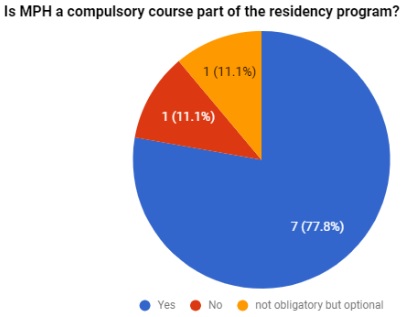
All members present at the Strasbourg meeting, representing eight of the nine countries that are part of EuroNet-MPRH, participated at the survey, which consisted in a single question “Is MPH a compulsory course part of the residency programme?”. Ireland, the remaining country, received the survey via email.

All countries, except Italy and Ireland, declared to have a MPH programme as part of their residency training programme. In Ireland, MPH is optional (See figure 1). Regarding commitment and time-dedication, 33%(3/9) of the surveyed countries reported the presence of part-time MPHs, while 44% (4/9) reported full-time commitment programmes.

Figure 1

Fees are more often covered by the employer then students, except in France, where trainees must sustain the fees by themselves. In three countries costs are covered by the ministry.

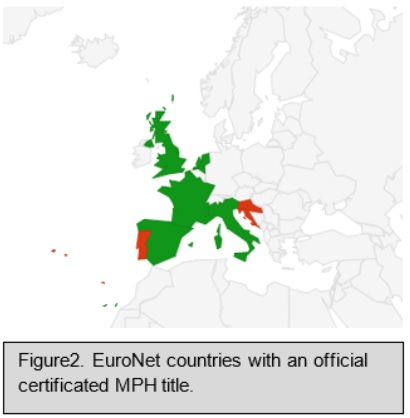
All countries except Portugal and Slovenia have an official MPH title. Although Croatia has an official MPH title, they are unsure about the accreditation status. Schools in Portugal are encouraged to consider MPH programmes as the academic part of a master programme, where students pay an extra fee to present a thesis and to obtain a degree. Slovenia hopes to have one in the future (See figure 2).

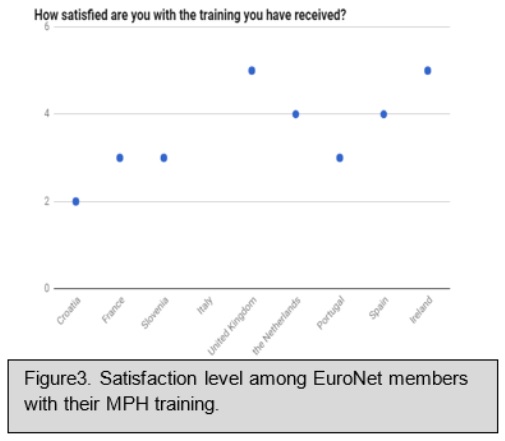
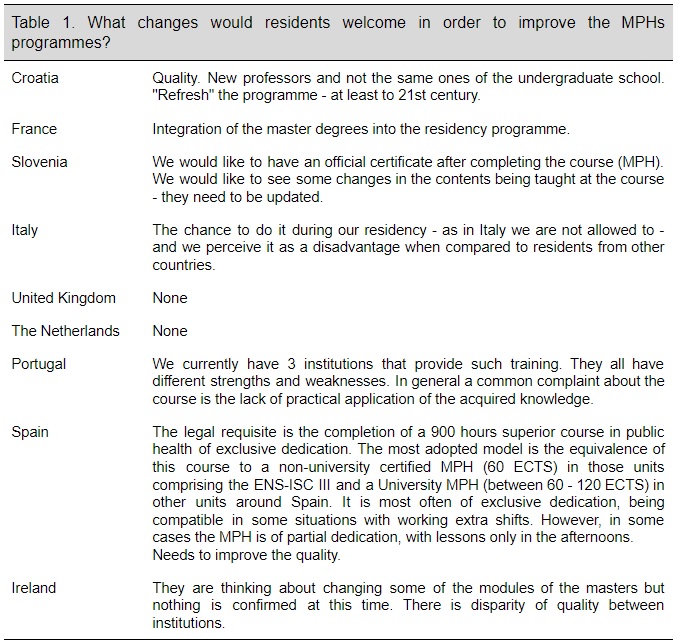
The residents satisfaction with the training received during the MPH was assessed with the question “How satisfied are you with the training you have received?”. The results show a median satisfaction of 3.5 points out of 5 [IQR: 2-5] (See figure 3).  Moreover, residents were asked about what kind of changes they would like to observe inside the MPHs programmes (Table 1).

As presented, there are great disparities among different MPH programmes across Europe. It would be desirable to further unify MPH criteria in order to increase training quality and mobility.

_________________________

References

  1.  Inamo J. et al. Existe-t-il des spécificités dans la prévalence et la prise en charge de l’hypertension artérielle aux Antilles-Guyane par rapport à la France métropolitaine ? BEH thématique, 16 décembre 2008 ; 49-50. Romon I. et al. Le poids important du diabète sur la mortalité dans les départements d’outre-mer. InVS, Mars 2007.
  2. Jaries R. et al. Population movements and the HIV cascade in recently diagnosed patients at the French Guiana -Suriname border., 2017; 13:1-5
  3. Carde E. Les discriminations selon l’origine dans l’accès aux soins. Access to health care and racial discrimination. Santé publique 2007, volume 19, n° 2, pp. 99-109.

_________________________

Fátima C. Mori Gamarra
Preventive Medicine and Public Health resident at Complexo Hospitalario Universitario de Ourense, Galicia – Spain

Julio Muñoz Miguel
Preventive Medicine and Public Health resident at Hospital Clínico Malvarrosa, Valencia – Spain

Adrían Aginagalde Llorente
Preventive Medicine and Public Health resident at Hospital Universitario de Cruces – Spain

(As published in EuroNews #13)

EuroNet MRPH logo with the full name of the network, European Network of Multidisciplinary Residents in Public Health.

ASPHER, EuroNet MRPH. Joint Statement on Public Health Workforce Development and Professionalisation

EuroNet MRPH, the European Network of Medical Residents (and Trainees) in Public Health, is happy to announce that it signed the Joint Statement on Public Health Workforce Development and Professionalisation: Call for a collaborative and consensus-building action.
ASPHER, the Association of Schools of Public Health in the European Region, led on the development of this Joint Statement in collaboration with various organisations and members of the EU Health Policy Platform.

ASPHER, EuroNet MRPH and other signatory organisations call for a collaborative and consensus-building action on the continuing development and professionalisation of the public health workforce in Europe.
This call takes into account the critical momentum in the relevant policy contexts (Action Plan for the EU Health Workforce and the European Action Plan for Strengthening Public Health Capacities and Services of the WHO Regional Office for Europe), the different perspectives and initiatives with regard to strengthening the public health workforce and aims to underline the need of an interdisciplinary and inter-professional action.

Please, download here the Joint Statement on Public Health Workforce Development and Professionalisation document.